
There's one sentence I hear more than any other at the end of a retreat day.
"We wish we'd done this years ago."
It's the most common feedback I get. Couples walk out exhausted and hopeful, and somewhere in there is a little grief, too. Because they finally feel safe with each other again, and they can't help but think about all the years they spent feeling lonely, resentful, and stuck in the same fight.
If you're reading this and wondering whether it's time to get help, this post is for you. Let's talk about why couples wait, what waiting really costs, and why, if there's still love between you, it's not too late to start marriage counseling in Raleigh NC.
What Shifts When Couples Finally Get Help
When couples tell me they wish they'd started sooner, here's what has usually changed for them:
They feel emotionally safe with each other again.
They understand each other. Not just the words, but what's underneath them.
They can send a message that actually lands. When one of them reaches, the other can receive it.
They're aware of their own emotional experience, and of their partner's.
They take ownership of their own feelings.
That last one is a big deal. When you take accountability for your own emotional experience, your partner feels validated. And when your partner feels validated, they feel safer. Which makes it easier for them to do the same for you. Safety builds on itself.
So why does it take so many couples so long to get there?
Most Couples Wait Years Before Getting Help
You'll often see it said that couples wait six years before getting help. Newer research suggests it's closer to two or three years for most couples. But in my office, the couples I see have often been stuck in the same patterns for five, ten, even fifteen years.
That's a lot of years of lonely dinners, a lot of resentment, and a lot of the same fight on repeat.
Why Couples Wait So Long
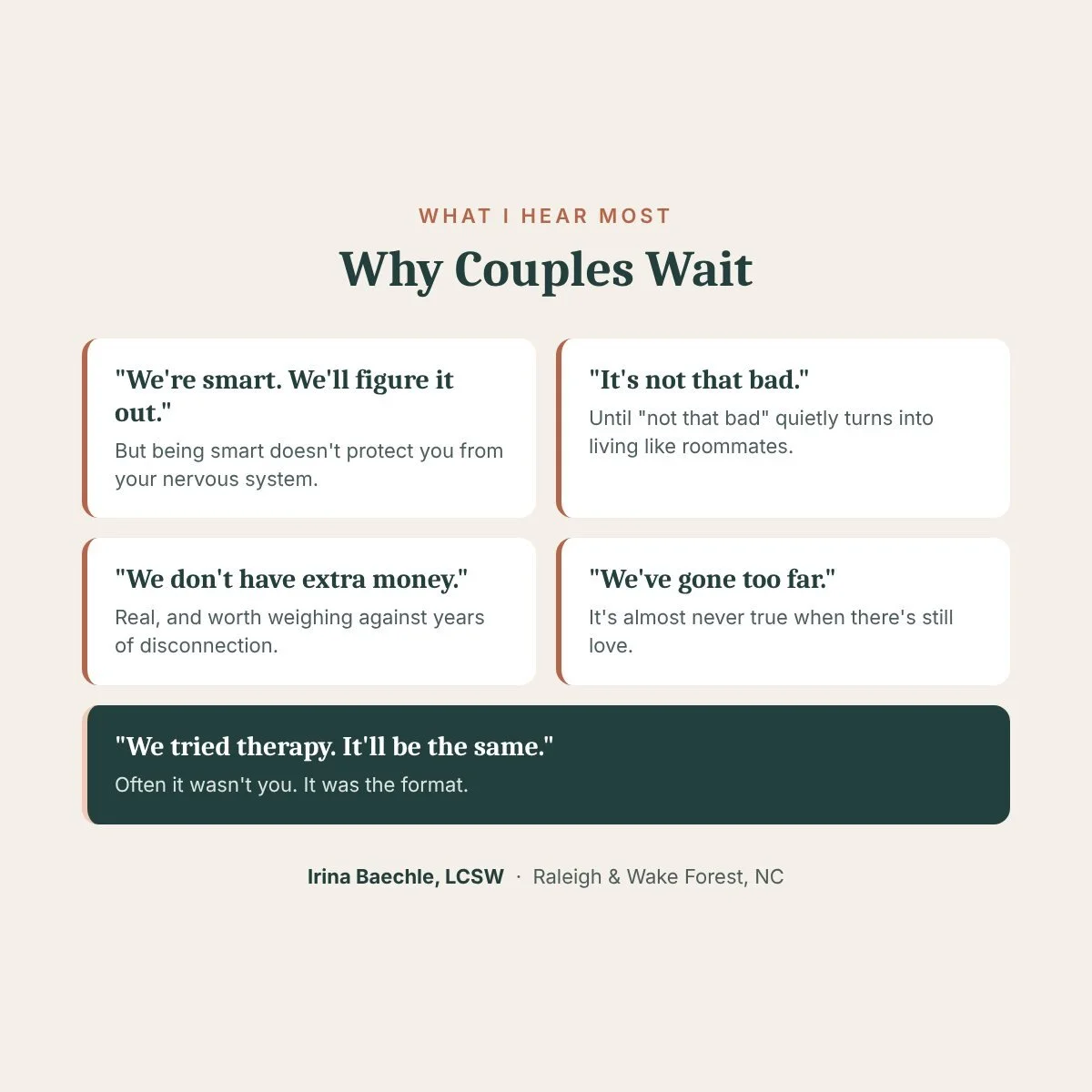
I hear the same reasons over and over. Maybe you'll recognize yourself in one of them.
"We're smart. We thought we could figure it out."
A lot of the couples I work with are high achievers. They run teams, companies, and households. They've figured out almost everything else in life, so of course they assume they can figure this out, too.
But being smart doesn't protect you from your nervous system. When you feel threatened by the person you love most, everything you know goes out the window. That's not a failure of intelligence. It's how we're wired.
"It's not that bad. Why do we need someone else?"
You're not screaming at each other every night. Nobody's having an affair. Other couples seem worse off. So you tell yourselves it's fine.
But "not that bad" can quietly turn into living like roommates. And the longer the distance sits there, the more normal it starts to feel.
"We don't have extra money."
This one is real, and I don't want to brush it off. Therapy is an investment. But it's worth comparing what you'd spend now to what years of disconnection cost you, emotionally and financially. I talk more about how to weigh this in couples retreat or weekly marriage counseling in Raleigh NC.
"We've probably gone too far. No one can help us."
By the time the pain gets big enough to reach out, a lot of couples have already decided it's hopeless. I'll come back to this one in a minute, because it's almost never true.
"We've done therapy before. It'll probably be the same."
If you've been through weekly therapy that didn't change much, I completely understand the hesitation. How do you know this time will produce different results?
Here's what I'd say: very often, it wasn't you, and it wasn't your relationship. It was the format. I explain why in why 50 minutes a week isn't enough.
What Waiting Actually Costs
The patterns get deeper
This is the biggest difference I see between couples who wait and couples who come in earlier. Couples who wait a long time come in with five, ten, fifteen years of repeating patterns that don't work. Couples who come in earlier have many fewer years of those patterns, so they can undo and unlearn them faster and better.
Think of it like walking into a forest. If you walked ten miles in, you're not walking out in five. The longer you've been walking, the longer it takes to find your way back. I go deeper into why repetition matters so much in why progress doesn't stick when there's a week between sessions.
The loneliness becomes normal
You stop reaching for each other because reaching hurts too much. Conversations shrink to logistics: pickups, bills, whose turn it is to cook. Intimacy fades. You share a house, but not a life.
Your kids are watching
Most of the couples I work with have kids. And this is the cost that weighs on parents the most.
Kids feel the tension in a house, even when nobody says a word. They notice the silent dinners, the sighs, the doors that close a little too hard. They notice when Mom and Dad don't touch, don't laugh, don't look at each other.
And kids learn about love by watching you. The way you handle conflict, the way you repair (or don't), the way you reach for each other (or don't). That becomes their blueprint for their own relationships one day.
In fact, one of the biggest reasons couples tell me they come to see me is their children. They want to set a good model for them. And when they talk about their kids in my office, I see the tears. Their hearts are hurting.
Here's what I hear once couples reconnect. Their relationship with their children improves. Their kids want to spend more time with them, even the teenagers. They become more aware of what they inherited from their own parents and what they don't want to pass on, so they parent more consciously. And a lot of them start working less and spending less energy on the things that don't really matter.
One couple I worked with is a perfect example. He thought his wife wanted more money. She'd talk about how the neighbors went places and did more than they did, and he heard that as pressure to earn more. Then they finally talked about it in session, and she said, "No. I don't really care about anyone else. I want you more present. I don't want you to work more. I want you to work less, and I want us to spend less."
That changed everything. He started working less. He was more available at home. And their kids' behavior at school improved, too.
Here's the hopeful part. When you repair your relationship, your kids get to see that too. They get to see two people who hurt each other find their way back. That might be one of the most powerful things you ever teach them.
"Is It Too Late for Us?"
I get asked this a lot. Here's my honest answer.
It's never too late, unless there's no love left between you. If the relationship has become just a habit, or if you're only staying together for the kids, that's a different situation, and a retreat probably isn't the right next step.
But if there is love, even if there's a lot of pain, it's never too late.
I've seen couples come in convinced they've gone too far. Couples who haven't had a real conversation in years. And once they slowed down and their defenses softened, they found each other again underneath all the hurt. Not because the pain disappeared, but because they finally understood what was driving it, and realized they were on the same team.
There are a few situations where other support needs to come first, like active abuse, an active affair, or active addiction. I lay out who a retreat is and isn't for in my guide to why a couples retreat gets you further than months of weekly sessions.
You Don't Have to Be on the Brink of Divorce
You don't need to wait until you're packing bags. The best time to start is when you're tired of feeling disconnected.
It might be time if:
You keep having the same fight, just with different details
You feel more like roommates than partners
One of you feels alone, and the other feels criticized
You've stopped reaching for each other because it hurts too much
You're worried about what your kids are learning from your relationship
The earlier you start, the fewer years of patterns we have to untangle, and the faster things can start to feel different.
What Starting Now Can Look Like
In my practice, couples start with a 2-day retreat, then continue with one full retreat day a month for 12 months or longer. No rushing, no cliffhangers, and enough time to actually feel something shift between you. If you want to know exactly what a retreat day looks like, I walk through it in what actually happens during a couples retreat in North Carolina.
You don't have to add another year to the list. You just have to start.
About Irina Baechle, LCSW

Hi, I'm Irina Baechle, a licensed clinical social worker and marriage therapist in Raleigh and Wake Forest, NC. For more than 15 years, I've helped couples move out of painful, stuck places and back toward each other.
I'm trained in Emotionally Focused Therapy (EFT), the most research-backed approach I know for healing emotional distance and rebuilding trust. When it's appropriate, I also use brainspotting and ketamine-assisted psychotherapy to expedite results. I've offered couples retreats since 2017, and today it's the only way I work: a 2-day start in my cozy private office in downtown Wake Forest, then monthly 1-day retreats for 12 months or longer. You can read the full picture in my guide to why a couples retreat gets you further than months of weekly sessions
I believe in the power of healthy relationships, and I want healthy, trustworthy marriages to be the norm, not the exception. I'm direct, I'm warm, and I'll tell you what I see without shame.
Topics I write about include marriage, infidelity, roommate marriages, sexless marriage, ketamine-assisted psychotherapy, healthy second marriages, and healing after toxic or unfaithful marriages.