
You had a great session. Maybe the best one yet. Your partner said something you'd never heard before, something softened between you, and you held hands walking out to the car.
Three days later, you're having the same fight. Same words, same tone, same slammed door.
If that sounds familiar, I want you to hear this first: it doesn't mean the breakthrough wasn't real. And it doesn't mean you're bad at this. It means a breakthrough needs a lot more than one good hour to survive a week of real life.
If you're looking into marriage counseling in Raleigh NC because weekly sessions keep giving you good moments that don't last, this post is for you.
The Session Was Good. So Why Are We Back Here by Saturday?
When progress slips, most couples blame themselves. We must be doing it wrong. Maybe we're just not compatible. Maybe we need to try harder.
A lot of the couples who come to my office are high achievers. Executives, physicians, business owners, people who run teams and solve hard problems all day long. They know how to do almost everything. And they carry a lot of shame and guilt about the one thing they can't seem to figure out: how to connect with their partner, how to repair after a fight, how to talk to each other in a way that actually works.
So they try harder. They read the books. They white-knuckle their way through the next argument.
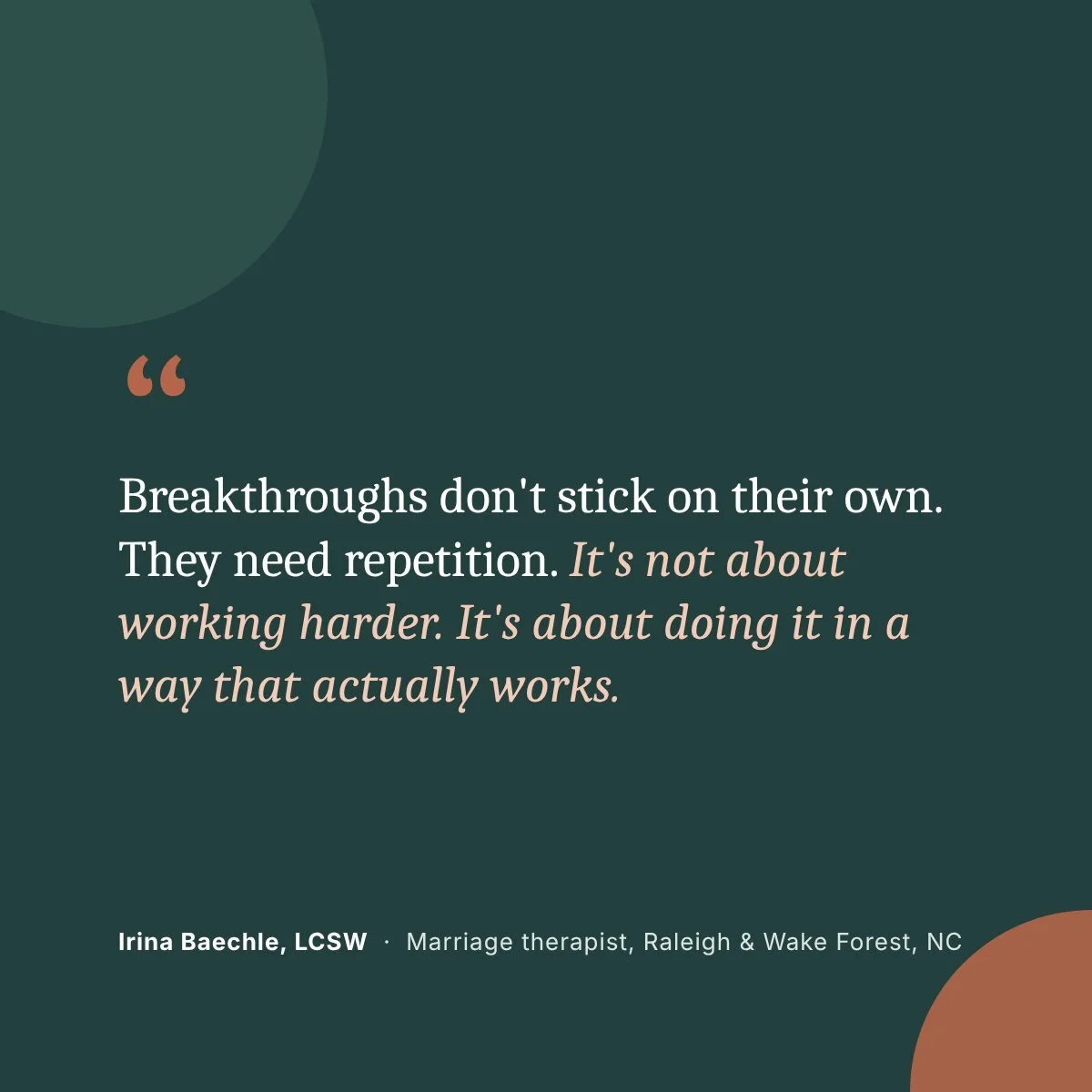
But here's the thing. It's not about working harder. It's about doing it in a way that actually works.
I wrote about what goes wrong inside a 50-minute session in why 50 minutes a week isn't enough .This post is about what happens after you walk out the door.
What Happens to a Breakthrough Over Seven Days
Let me tell you about a couple I worked with back when I still offered weekly sessions.
Their pattern went like this: she yelled and criticized, he felt attacked and got defensive, and round and round they went. Then one session, something clicked for him. He realized that underneath all that yelling, his wife felt deeply alone and unloved.
He said something like, "I would have never known that. I thought she hated me. I didn't know she felt alone. I didn't know she actually needed me, and that this was her way of reaching for me."
That session ended so beautifully. There was so much empathy and understanding in the room.
Then two days later, she got loud. He felt criticized. Three days after that, it happened again. And again a few days later. Every time, he forgot what was underneath it. He forgot how alone she felt. All he could see was her anger.
And honestly? That makes total sense. Anger is the easiest thing to see. It's right there in your face.
So what happened to his breakthrough? A few things.
Your head understood it. Your nervous system didn't get the memo.
In session, he understood his wife with his thinking brain. But the fight doesn't run on the thinking brain. It runs on the deeper, emotional, survival part of the brain, the part that decides in half a second whether you're safe or under attack. One good conversation isn't enough to teach that part of you anything new.
Life rushes into the gap.
Between sessions, there's work, kids, money, in-laws, and every single trigger you already had. And there's nobody in the room to slow things down when the cycle starts.
The next session starts with damage control.
By the time you come back, you've had two more fights. So we spend the session cleaning up the week instead of building on the breakthrough. It's like climbing halfway up a mountain and then starting from the bottom again every single week.
"If It Were a Real Breakthrough, It Would Stick"
This is the misconception I hear most, and I want to push back on it hard.
Breakthroughs don't stick on their own. Ever. Our brains learn through repetition. If you walked ten miles into the forest, you're not walking out in five. And by the time most couples reach my office, they've been having the same fight for two years, five years, fifteen years. That's a long way into the woods. It takes time to untangle and unlearn it.
And you can't think your way out of it, because nothing changes cognitively. The change has to happen deep in the subcortical brain, where our hurts and traumas are stored, so we can reorganize those experiences and create real safety.
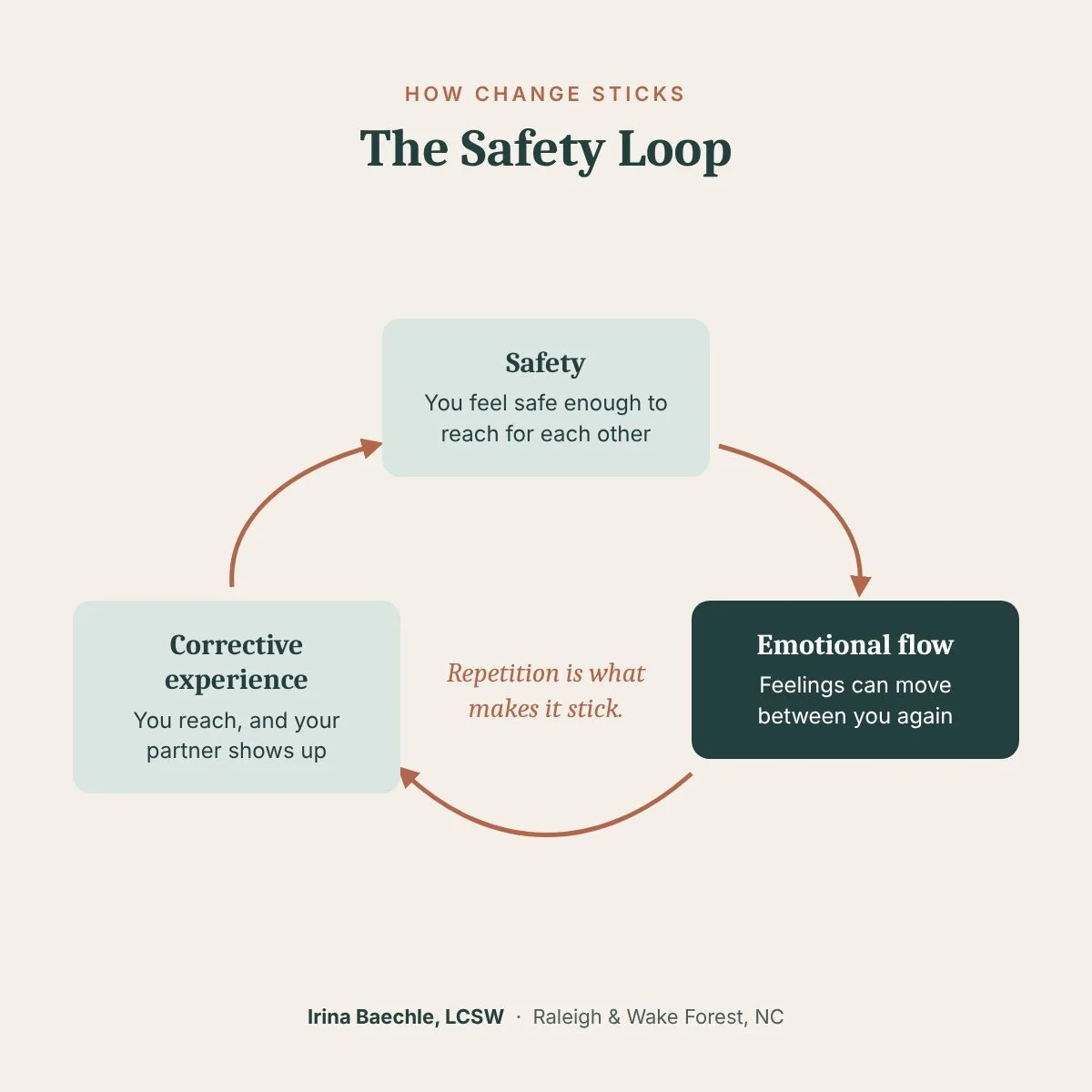
Here's how it works. To create safety, you need emotional flow between the two of you. To create emotional flow, you need corrective emotional experiences, those moments where you reach for your partner and they actually show up. And to have corrective emotional experiences, you need safety. Each one feeds the next, and the loop only gets stronger with repetition.
Which is why trying harder doesn't help. You don't need more effort. You need more repetitions, with enough time to actually feel them.
"But Wait, Isn't a Month Even Longer Than a Week?"
Fair question. If a week is too long between weekly sessions, why does a month between retreat days work?
Because they're doing completely different jobs. A retreat day gives us enough time to create the new emotional experience and repeat it until it lands. The month in between is for integration: practicing it in real life, again and again.
Remember my couple? When I moved my practice to couples retreats only, we finally had six hours together. Over those six hours, he heard his wife's words several times: when she yells, she feels lonely. He heard it, felt it, and heard it again. We got it into his bones. His nervous system had time to metabolize it.
The following month, they came back with a story. She had been yelling at him, and instead of getting defensive like he used to, he remembered. He said, "You must be feeling really alone right now. I want to understand more. Can you tell me more?"
That one sentence changed the cycle. It softened her. Her softening made him less defensive. And they had a good conversation, maybe the first one in a long time that started with yelling and ended with closeness.
That's the difference. Not more insight. More repetition, and enough time for it to sink in. I go deeper into why this format works in my guide to why a couples retreat gets you further than months of weekly sessions.
What the Month Between Retreat Days Actually Looks Like
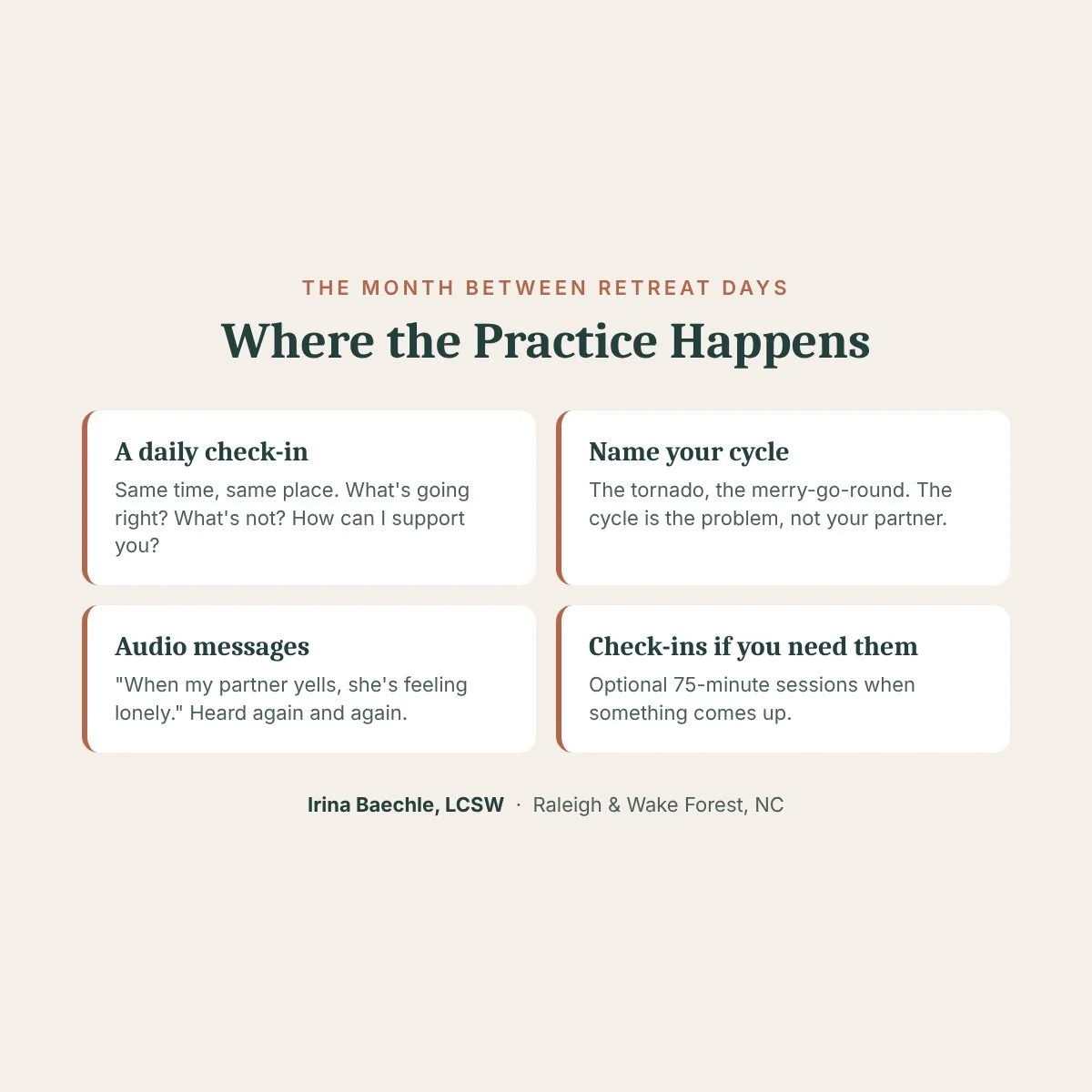
The time between retreats isn't downtime. It's where you practice. Here's what that includes.
A daily check-in (the homework I give the most)
You agree on the same time and the same place every day. Your living room, your front porch, 6 a.m. with coffee. I encourage couples to do it in the first half of the day if they can, instead of at night when you're both exhausted and running on empty.
Then you talk about three things: What's going right? What's not going right? How can I support you better?
Keep it very, very short. In the beginning, five minutes is plenty. Over time it grows on its own, because it starts to feel good. And yes, I'll ask about it at your next retreat, and I'll call you out if you skipped it.
Naming your cycle
I have every couple give their cycle a name. Some call it the tornado. Some call it the merry-go-round. One couple calls it the shitstorm. Some just call it the cycle.
The name matters less than what it does. When you can say "we're in the tornado again," you stop seeing your partner as the enemy. It's not Partner A who's the problem, and it's not Partner B. The cycle is the problem, and you're on the same team against it.
Customized audio messages
At the end of each retreat day, we decide together what you want to remember. Then I record it as a customized audio message for you to listen to between retreats. Things like:
I know that when my partner yells at me, she's feeling lonely.
I know that when my partner pulls away, he's feeling anxious.
I understand now that my partner is turning away from the conflict, not from me.
You listen on your commute, on a walk, before your check-in. You hear it over and over, because that's exactly what your nervous system needs. Repetition.
Support when you need it
If something big comes up mid-month, there are optional 75-minute check-in sessions so you don't have to white-knuckle it alone until the next retreat day.
Each Retreat Day Starts Where the Last One Left Off
This is the part couples love. Because you've been practicing all month, we don't start from the bottom of the mountain. We pick up where we left off and add the next layer. It's scaffolding. Each month builds on the one before.
That's why my couples commit to 12 months or longer. Patterns that took years to form, and often started in childhood, need enough repetitions to change for good. By around month three, most couples notice their cycle de-escalating. By month twelve, they're not just fighting less. They feel safe enough to mess up and repair.
If You Keep Sliding Back, It Might Be the Format
Here are a few signs it's time to try something different:
You've had genuinely good sessions, but nothing seems to last.
You can describe your cycle in your sleep, but you can't stop it when it counts.
You leave therapy hopeful and you're back at square one within a week.
You've started to wonder if therapy just doesn't work for you.
If that's you, please hear me: you didn't fail, and neither did your partner. You've probably been doing the work. What you haven't had is enough uninterrupted time to feel something new together, and enough repetition for it to stick.
That's exactly what a retreat is built for. You don't have to keep turning around halfway up the mountain every week.
About Irina Baechle, LCSW

Hi, I'm Irina Baechle, a licensed clinical social worker and marriage therapist in Raleigh and Wake Forest, NC. For more than 15 years, I've helped couples move out of painful, stuck places and back toward each other.
I'm trained in Emotionally Focused Therapy (EFT), the most research-backed approach I know for healing emotional distance and rebuilding trust. When it's appropriate, I also use brainspotting and ketamine-assisted psychotherapy to expedite results. I've offered couples retreats since 2017, and today it's the only way I work: a 2-day start in my cozy private office in downtown Wake Forest, then monthly 1-day retreats for 12 months or longer. You can read the full picture in my guide to why a couples retreat gets you further than months of weekly sessions.
I believe in the power of healthy relationships, and I want healthy, trustworthy marriages to be the norm, not the exception. I'm direct, I'm warm, and I'll tell you what I see without shame.
Topics I write about include marriage, infidelity, roommate marriages, sexless marriage, ketamine-assisted psychotherapy, healthy second marriages, and healing after toxic or unfaithful marriages.