Brainspotting North Carolina
When you need to work on your own stuff first before you can work on your relationship together
When Your Partner Won't Come to Therapy (But You're Ready to Change Everything)
You're lying awake at 2 AM, replaying the fight in your head for the hundredth time.
You know something has to change. You can feel the distance growing between you. You see the pattern—the defensiveness, the blow-ups, the awful cycle that keeps repeating. So you suggested couples therapy. And even googled a marriage retreat near me. And they said no.
Maybe they don't "believe" in therapy. Maybe they think you're the one with the problem. Maybe they're too hurt, too tired, or too convinced it won't help. And now you're stuck, thinking: "What's the point of going alone? I can't fix this by myself."
Here's What You Need to Know
You're right—you can't change your partner. But you can absolutely change the dance. Because here's the truth: the cycle between you isn't just about what they do. It's about how you both respond to each other, and when you change your steps, the entire pattern shifts.
Think about it:
When your gets upset and you feel that surge of defensiveness—that's your nervous system reacting to an old wound. When you blow up because it feels unbearably unfair—that's your pain reaching a breaking point. When you shut down or storm out—that's your protection mechanism kicking in.
And all of that? You can work on. Right now. Without your partner in the room.
Brainspotting North Carolina

Hi, I'm Irina, a relationship therapist who helps people discover their true selves and cultivate thriving healthy relationships.
I'm not here to promise magic solutions or quick fixes. What I offer is a path, a path to understanding yourself, loving yourself, and from there, fostering the connections you yearn for. Even if your partner won’t come to marriage counseling (now or ever). Even if your relationship ended. Or you first want to invest in some individual work and are not quite ready for couples work just yet.
You don't have to be in marriage counseling to learn how to be part of a healthy relationship.
In couples counseling for one, we'll start with the relationship with you so you truly learn what it looks like to love you. And then, once you figure that out, we'll dive into how to create more loving relationships out in the world. With lovers, with friends, and with family. And here's the secret: it's not about perfecting yourself, but about embracing your imperfections with compassion. Through the lens of self-awareness, we'll uncover the layers that make you who you are—your dreams, your scars, your strengths. It's about learning to hold your own hand before you intertwine fingers with another's.
“Irina is a remarkably skillful therapist. She knows how to guide a couple from dancing the polka of disconnection into a harmonious connected tango. She marries deep expertise with broad experience. It’s exciting for me to send clients her way as I know they will come out of their time with her with clarity and connection.”

Frequently Asked Questions
If you have been wondering how Brainspotting North Carolina actually works and whether it is right for you, you are in the right place.
I also offer couples retreat North Carolina and marriage counseling Wake Forest NC for partners who are ready to heal together.
-
It's body based healing that goes way beyond talking. Where you look affects how you feel, and by finding the right eye position we can access emotions stored deep in your nervous system, the kind that years of talking have never been able to touch. It's fast, it's deep, and it works at the root.
-
Yes. And honestly, it might be the most powerful thing you can do for your relationship right now.
You can't change your partner. But you can absolutely change the dance. When you shift how you show up, the entire dynamic shifts with you. Your partner doesn't have to be in the room for that to happen.
-
Because your relationship is hurting now, not in six months. Weekly therapy means 45 minutes once a week, half of which is catching your therapist up on Tuesday's fight. An intensive means six uninterrupted hours going deep, processing what's actually driving your reactions, and walking out genuinely different. One intensive does what ten weekly sessions often can't.
-
You come into my cozy private office in Wake Forest, get comfortable, and we slow everything down. I guide you to notice where an emotion is held in your body, find the eye position connected to it, and then your nervous system does the work. You don't have to explain it or make it make sense. Some people talk. Some don't. Both are fine. You leave lighter.
-
Sometimes the wounds run deep enough that we need extra support to reach them. When that's the case I combine Brainspotting with Ketamine Assisted Psychotherapy to quiet the brain's defenses and access what's been locked away for years, or with EFIT principles to help you understand the attachment wounds driving your reactions. We figure out together what combination makes the most sense for you.
-
It's for the partner who is done waiting. Done lying awake replaying the same fight. Done feeling like no matter how hard you try it's never enough. Ready to stop reacting from old wounds and start showing up as the person you actually want to be, in your relationship and in your life.
But it's not only for people in struggling relationships. Individual Brainspotting is also for people who are single, divorced, or not in a relationship at all and are carrying stuff that has nothing to do with a partner. Anxiety that won't quit. Depression that talk therapy hasn't touched. Trauma from childhood, past relationships, or life experiences that keeps showing up in ways you can't fully control. The chronic feeling of not being enough. ADHD. Grief. The exhaustion of holding everything together while quietly falling apart on the inside.
You don't need a partner or a relationship problem to deserve this work. You just need to be ready to stop surviving and start actually living.
-
I get it. Eye positions and nervous systems and body sensations. It sounds like something you'd see on late night infomercial.
But here's the thing. Your body already knows this works. You've experienced it your whole life without realizing it.
Ever notice how looking down makes it easier to access a sad memory? How you look up and to the right when you're trying to remember something? How you can't quite meet someone's eyes when you're ashamed? That's not random. Your eye position and your emotional state are constantly connected. Brainspotting just uses that connection intentionally and precisely to locate where specific experiences are stored in your nervous system.
It's not woo. It's neuroscience. And it's backed by a growing body of research showing it works faster and deeper than traditional talk therapy for trauma, anxiety, depression, and a whole range of conditions that have their roots in the body rather than just the thinking brain.
The weird part, if there is one, is actually how simple it is. You get comfortable, I guide you to notice something in your body, we find the eye position connected to it, and then your brain and nervous system do what they were literally designed to do. Process. Release. Reorganize.
You don't have to understand it fully for it to work. You just have to be willing to try something that goes deeper than what you've already tried. And if what you've already tried hasn't gotten you where you want to be, weird starts to sound a lot more appealing.
-
Nope. People fly and drive in from all over the country to do this work.
The closest airport is RDU, Raleigh Durham International, easy to get in and out of from most major cities. My office is a straightforward drive from there in Downtown Wake Forest.
If you're traveling in, build a buffer. Don't schedule your flight home the morning after your intensive. That integration time is not optional, it's where the work lands. Give yourself the day after to just be.
For lodging, The Umstead Hotel and Spa in Cary is stunning if you want to go all out and treat this like the investment it is. If you want something more homey and flexible, Airbnb has great options in and around Wake Forest and Raleigh. Either way, stay somewhere you'll actually enjoy. You're not here to suffer through a budget motel between the most meaningful days you've had in years.
-
One full day intensive is $3,500.
That's six hours of deep, focused, uninterrupted work. No weekly drip. No starting over every seven days. Just one day that gets you further than months of traditional therapy.
Insurance doesn't cover it. That's the honest answer.
Here's the other honest answer. Most people who come to me have already spent years in weekly therapy, circling the same pain without it actually moving. When you do that math, one intensive starts to look very different. You're not paying for more of the same. You're paying to finally get somewhere.
And if you need more than one day? We build a plan together. Some people do two days back to back. Some space them out. We figure out what makes sense for where you are and what you're carrying.
You are worth this investment. The version of yourself on the other side of this work is worth it.
-
Honestly? Most people feel something shift after the very first retreat. Not everything, but something. A lightness. A little more space between the trigger and the reaction. A quiet that wasn't there before.
But feeling better and staying better are two different things. One session can crack something open. Six to twelve sessions is where it actually rewires. That's not me upselling you, that's what the research shows. The brain needs repeated windows of neuroplasticity to form new patterns that stick. One session gives you a glimpse. twelve gives you a new nervous system baseline.
What I can tell you is this. You will not leave your first intensive the same way you walked in. Something will have moved. And if you do the integration work between sessions, journaling, rest, paying attention to what's different, that movement compounds.
How fast you feel better also depends on how long you've been carrying what you're carrying. Someone dealing with two years of anxiety heals differently than someone whose nervous system has been in survival mode since childhood. There's no shame in either. We just work with what's true for you.
What I refuse to do is promise you a timeline that sets you up for disappointment. What I will promise is that if you show up ready to do the work, something real will happen. Faster than you think. And deeper than you expected.
-
In my private cozy office in Downtown Wake Forest, NC at 201 Wait Ave.
It feels nothing like a sterile therapy office. Think warm lighting, comfortable mats, a space where you can actually exhale and let your guard down. A lot of people comment on how different it feels the moment they walk in. That's intentional. You can't do deep nervous system work in a cold clinical room.
Wake Forest is a charming small town just north of Raleigh, easy to get to from RDU airport, and surrounded by great coffee shops and restaurants for your breaks and downtime.
And if you're traveling in from out of state, no problem at all. People fly and drive in from all over the country. The Umstead Hotel and Spa in Cary is a beautiful option if you want to treat this like the full investment it is. Airbnb works great too if you want something more homey and private. Either way, stay somewhere that feels good. You're doing important work and you deserve a soft landing at the end of the day.
-
It gets to the root. Not the story about the root. Not an intellectual understanding of the root. The actual root, stored in your body, your nervous system, the part of you that reacts before your thinking brain even has a chance to catch up. That's where Brainspotting goes. That's why it works when talking hasn't.
It's fast. One six hour intensive moves more than months of weekly therapy. Not because we're rushing but because your nervous system finally has enough uninterrupted time and safety to actually complete the healing process instead of just scratching the surface every Tuesday at 3pm.
You leave different. Not with a new coping strategy. Not with homework you'll forget about by Thursday. With something that actually shifted inside you. People describe walking out feeling lighter, calmer, more themselves than they have in years. Sometimes ever.
Your reactions change. The triggers don't disappear overnight but your relationship to them does. The thing that used to send you from zero to a hundred starts to have a pause in it. That pause is everything. That's where choice lives.
It works on everything. Anxiety. Depression. Trauma. PTSD. Grief. Shame. The chronic feeling of not being enough. ADHD. The aftermath of divorce or betrayal. The exhaustion of holding it all together while quietly falling apart. If it's stored in your nervous system, Brainspotting can reach it.
It ripples outward. When you heal your own patterns, everything around you shifts. Your relationships. Your parenting. The way you move through conflict. The way you receive love. You don't just feel better in the therapy room. You show up differently in your whole life.
And the most important benefit of all? You stop just surviving. You start actually living.
-
No. Brainspotting is completely hands off.
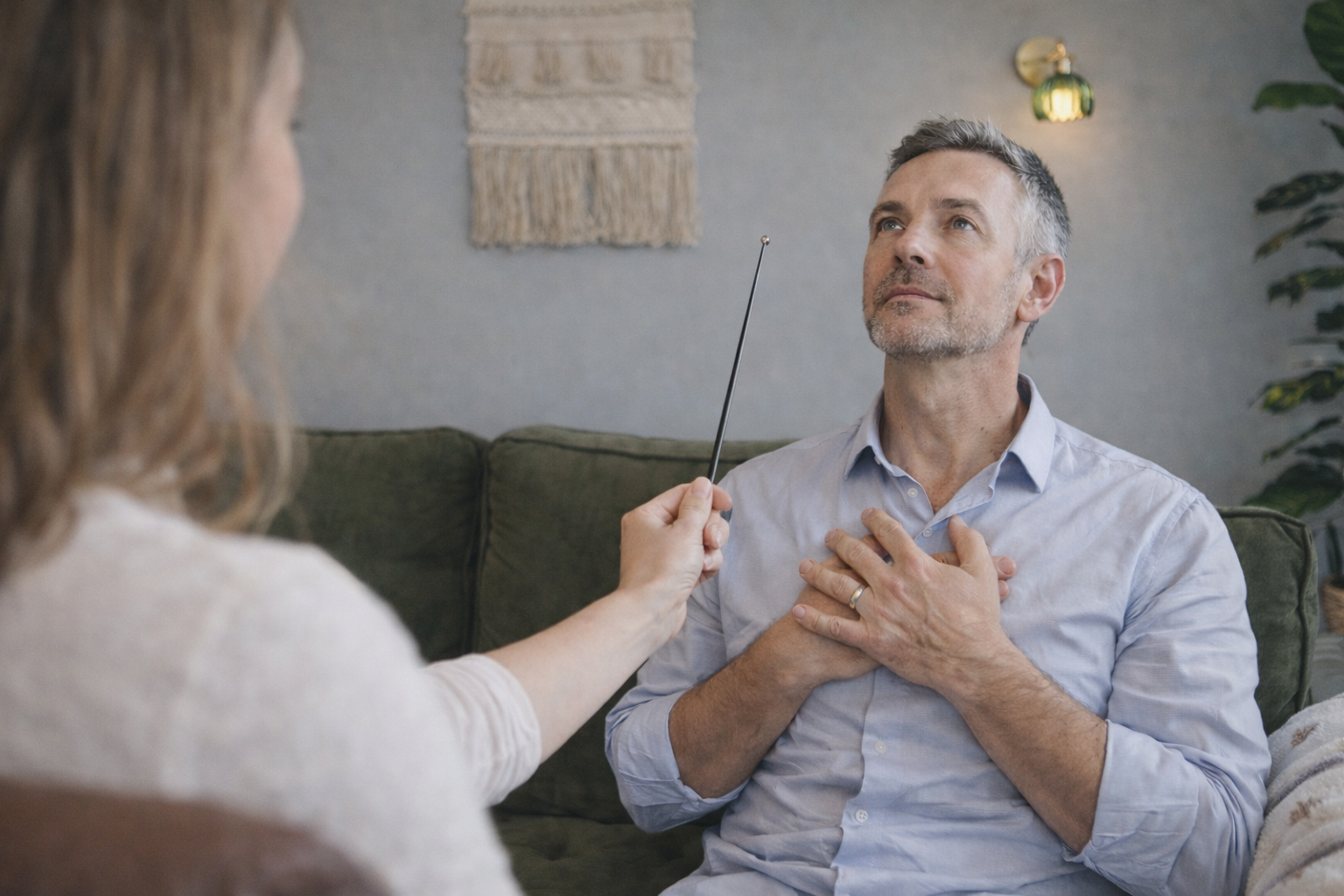
I use a pointer to help guide your eye position, and that's it. No touching, no physical contact, nothing that requires you to be in anyone's personal space. You stay in your own body, in your own experience, at your own pace. That's actually part of what makes it so powerful. The healing comes from inside you, not from anything being done to you.
The only exception is if we discuss touch beforehand and you explicitly consent to it for grounding purposes, like a hand on the shoulder if you feel overwhelmed or need to feel anchored. That conversation always happens ahead of time. Nothing ever surprises you.
Your comfort and safety are not negotiable here. The whole point of this work is to create enough safety that your nervous system can finally let go of what it's been holding. That doesn't happen if you don't feel completely safe in the room.
So no. You will not be touched. You will be seen, supported, and fully held in the space. But your body is entirely your own.
-
God no. That would be awful.
Brainspotting therapy is one part of the intensive, not the whole thing. A six hour day has a natural rhythm to it. We talk, we process, we do the Brainspotting therapy, we take breaks, we eat lunch, we integrate what came up. It flows.
The actual Brainspotting portion, where you're holding a specific eye position, typically runs in blocks. Your nervous system needs time to process what comes up and it also needs time to rest. We never push past what your body can handle. If you need to move, stretch, use the bathroom, take a breath, we do that. This isn't an endurance test.
Think of it less like staring at a spot for six hours and more like a full day of deep intentional work that happens to include some really powerful moments of stillness. The stillness is where the magic happens. But it's balanced with plenty of movement, conversation, and yes, real lunch breaks.
You will not leave exhausted and cross eyed. You will leave lighter.
-
Brainspotting is one of the gentler trauma modalities out there, but "gentle" doesn't mean it won't stir things up.
Because we're going directly to where trauma lives in the nervous system, emotions and memories that have been buried for a long time can surface. That can feel intense, uncomfortable, or even overwhelming in the moment. Some people feel emotionally raw or exhausted after a session. Others have vivid dreams or notice old feelings resurfacing in the days that follow.
This isn't a bad thing, it's actually the healing process doing its job. But it's worth knowing going in.
That's exactly why I don't offer standalone brainspotting sessions and send you home to figure it out alone. Everything we do happens inside a structured intensive, with proper preparation before and integration after. You're never left holding something we haven't worked through together.
If you have a history of severe dissociation or are in an acute mental health crisis, we'd want to talk through whether brainspotting is the right fit right now, or whether we need to build more stability first.
Bottom line: in the right hands, with the right preparation, brainspotting is very safe. The risks are real but manageable. And I take that seriously.
-
Honestly? Training is just the starting point.
Brainspotting is a powerful modality, but the tool is only as good as the person holding it. A good brainspotting therapist knows how to create a space that feels genuinely safe, not just clinically safe, but human safe. Where you don't have to perform or explain yourself or hold it together.
Beyond that, I'd look for someone who:
Has completed formal Brainspotting training (Phase 1 and 2 at minimum)
Has their own lived experience with trauma and healing, not just textbook knowledge
Works at your pace, not a protocol's pace
Stays present and attuned throughout the session, not just watching the clock
Offers real integration support after the session, not just a "see you next week"
Brainspotting goes to some deep places. You want someone who's been there themselves and knows how to hold that space without flinching.
I've done my own deep work. I know what it feels like to sit in that chair. And that's not something you can learn in a training manual.
-
Both are body-based trauma therapies that go deeper than talk therapy alone, but they work differently.
EMDR uses bilateral stimulation (eye movements, tapping, or sounds) to help the brain reprocess traumatic memories. It's structured, protocol-driven, and follows a specific sequence.
Brainspotting works by finding a specific eye position, a "brainspot", that connects directly to where trauma is stored in the nervous system. There's no script, no protocol to follow. It's more open, more intuitive, and in my experience, it goes deeper faster. The brain leads. I just hold the space.
Both are evidence-based and effective. I use Brainspotting because it aligns with how I work- slow, deep, body-centered, and highly attuned to what your nervous system needs in the moment. Not what a protocol says should happen next.
-
If you've been in weekly therapy for a while and feel like you're spinning your wheels, yes, probably.
Brainspotting intensives are a good fit if you:
Know something is driving your reactions but can't seem to get to the root of it
Feel like talk therapy has taken you as far as it can
Are ready to do deep work but don't have months or years to spare
Want real, noticeable change, not incremental progress measured in millimeters
Are willing to feel uncomfortable in service of actually healing
It's not the right fit if you're in an acute mental health crisis, severely dissociating, or not yet stable enough to go deep. In that case, we'd talk through what needs to happen first before diving into intensive work.
The honest truth? Most people who find their way to me have already tried the slow route. They're done dabbling. They want to actually move. If that sounds like you, brainspotting intensives were probably made for you.
Still not sure? That's what the free consult call is for, we'll figure it out together.
-
Book the free 30 minute consultation call. We talk about what's going on, I share my recommendations, and we figure out together what the right path looks like for you. No commitment, no pressure, just a real conversation.
What sets Irina as a Therapist in Raleigh NC apart?

I am more than a therapist with over a decade of clinical experience and years of specialized training.
I am also a mom, a wife, an immigrant, a business owner, someone who went through a divorce at a young age, someone who has been thrown up on by two kids at the same time. I have watched my child struggle with a learning disability and felt completely helpless. I have sat at the dinner table holding my breath every time my kid tries a new food, waiting to see if the rashes start, wondering if we're heading to the ER tonight.
I am a real person, and I love my work!
As a Highly Sensitive Person (HSP) and neurodivergent individual who has navigated her own share of heartbreak, I know firsthand how disorienting it can feel when your most important relationships begin to fracture. I have sat in the uncertainty of not knowing if my own story would have a good ending. I have had to rebuild my sense of self, my trust in love, and my belief that real connection was still possible for me. That lived experience is not separate from my clinical work, it is my clinical work.
So when you sit across from me, I am not just nodding and taking notes. I actually get it. The fear, the exhaustion, the grief, the love that somehow survives all of it anyway.
I am dedicated to helping you embark on a transformative journey of self-discovery, intuitive growth, and deeper connection. With both the knowledge and the empathy to meet you where you are, I will walk alongside you, not ahead of you, so I can truly see you and honor your pain. And I will not sugarcoat the hard stuff, because that would be doing you a disservice.
I know how to help you find your way back to yourself. Back to a place where you feel confident, loved, and genuinely joyful. I am here for every step of that journey.
Why Brainspotting Therapy Retreat North Carolina Instead of Weekly Therapy

Here's the problem with traditional weekly therapy when your relationship is on the line:
You don't have months or years to figure this out.
Your relationship is hurting now. The fights are happening now. The distance is growing now.
Sitting in a therapist's office for 50 minutes once a week, spending half the session catching them up on what happened since last Tuesday, making tiny incremental progress while your relationship deteriorates in real-time—that's not going to cut it.
You need something powerful. Something that actually gets to the root of why you react the way you do. Something that creates real, lasting change fast.
That's why I only offer Brainspotting Intensives.
Instead of spreading healing out over months of weekly sessions, we go deep in concentrated blocks of time—typically 6 hours in a single day or over several days.
What Makes Brainspotting Therapy Retreat North Carolina Different
1. We Get Past the Surface Fast
In weekly therapy, you spend the first 15 minutes catching up, the next 20 talking about surface-level stuff, and maybe—maybe—the last 15 minutes touching something real. Then the session ends and you have to wait another week. In an intensive, we dive deep from the start and get results fast.
2. Your Nervous System Actually Has Time to Heal
Remember that raw wound that gets triggered every time your partner criticizes you? That feeling that you're not good enough, that nothing you do will ever be enough? That's not stored in your thoughts—it's stored in your body, in your nervous system. And healing that takes more than talking about it for 45 minutes once a week.
Brainspotting works directly with your nervous system to process and release these wounds. And in an intensive format, your brain has the uninterrupted time it needs to actually complete the healing process, not just scratch the surface.
3. You See Real Change Immediately
After an intensive, you don't walk out thinking "that was a nice chat, see you next week." You walk out different. Lighter. Like something that's been weighing on you for years just... lifted. And when you go home to your partner that night or that weekend, you show up differently. You're calmer. Less reactive. More present. Your spouse notices. Immediately.
4. It Fits Your Life
You're juggling work, family, a relationship that's struggling. The last thing you need is another weekly commitment that drags on for months.
An intensive means you carve out one day a month, do the deep work, and move forward with real tools and real healing—not an endless cycle of weekly appointments.
Ready to Break the Cycle?
You've tried harder. You've collected more marbles. You've defended yourself until you're exhausted. What if there was a different way? What if you could heal the wound that makes every conflict feel like proof you're failing? What if you could show up steady, present, and whole—regardless of what your partner and kid does? What if you could do it in days, not months? That's what Brainspotting Intensives can give you.
You don't have to keep living in this cycle. Even if you're the only one ready to change—that's enough to start. And you don't have to wait. Let's do this work together, and let's do it right.
“Irina is such an insightful treasure. She will be your sounding board, a wonderful support system and give you the push you need to make changes. She will not judge you or anyone in your life, she simply listens and helps you find a way forward. She is very kind and presents honesty in a constructive way. I have worked with Irina on a professional level and she has coached me through personal experiences. Her objective perspective and critical thinking are profoundly beneficial. I recommend Irina to anyone that is struggling with a relationship in their life or just needs a supportive and healthy way to get things off their chest.”
When You Need Even Deeper Healing
Sometimes the wounds run so deep that even Brainspotting intensives need extra support to reach them. Maybe you've been carrying shame since childhood. Maybe the voice telling you "you're not good enough" has been there so long you can't remember life without it. Maybe the defenses you've built are so thick that accessing the pain underneath feels impossible.
That's when we might combine Brainspotting with other powerful modalities.
Ketamine Therapy North Carolina

Ketamine works differently than traditional therapy or even Brainspotting alone.
It temporarily quiets the defensive walls your brain has built, creating a window where you can access and process wounds that have been locked away for years—sometimes decades.
When appropriate, we can integrate low-dose ketamine into your intensive work to:
Reach wounds that talk therapy can't touch—the preverbal trauma, the deep shame, the pain that lives below conscious awareness
Soften the rigid defenses that keep you stuck in reactive patterns
Create profound shifts in how you see yourself, your worth, and your relationships
Accelerate the healing process so you can move through years of pain in hours instead of months
This isn't about escaping reality or numbing out.
It's about creating the neurological space for real, lasting transformation.
The Power of EFT (Emotionally Focused Therapy) Principles

Even though your partner isn't in the room, the work we do together is deeply informed by Emotionally Focused Therapy (EFT) and Emotionally Focused Individual Therapy (EFIT) —the gold-standard approaches for relational wounds and struggles.
EFIT teaches us that beneath every defensive reaction, every blow-up, every shutdown, there's a deeper emotion and a core need:
Beneath your rage is the fear that you're not good enough
Beneath your defensiveness is the need to be seen and valued
Beneath your shutdown is the terror of being rejected or found inadequate
In our intensive work together, we use Emotionally Focused Individual Therapy (EFIT) principles to:
Identify the attachment wounds driving your reactions
Understand the cycle you're stuck in and your role in it
Learn how to communicate your deeper needs instead of defending from fear
Practice new ways of reaching for connection instead of protection
Even working alone, you're learning the language of emotional connection. You're understanding what's really happening beneath the surface of your fights.
And when you learn to recognize and express your own deeper needs, everything changes.
You stop fighting about the plumber or the text message. You start being able to say: "When you got upset, I felt like I was failing you, and that terrifies me because I'm trying so hard."
That's vulnerability. That's real. That's what creates change. And even if your partner isn't ready for therapy yet, when you start showing up this way—open, honest, emotionally available, it shifts everything between you.
If you are unsure what retreat is best for your unique needs, don’t stress. Not knowing is actually very common and normal. After discussing everything during the phone consult, I will share all my recommendations with you, so you can understand and decide.