
You’re 40 minutes into your session. You finally said the thing you’ve been swallowing for months. Your partner’s face changed. Something real is happening in the room.
And then your therapist says, “We’re almost out of time. Let’s pick this up next week.”
If you’ve been in weekly couples therapy, you know this moment. You also know what comes next: you walk out raw, you go straight to school pickup or a work call, and by the time next week rolls around, the moment has closed and you’re starting over.
If you’re looking into marriage counseling in Raleigh NC and wondering why weekly sessions haven’t gotten you very far, I want to offer a different explanation than “we’re hopeless.” It’s probably the format. Fifty minutes a week is built for scheduling convenience, not for the kind of deep work that changes how two people feel with each other.
The 50-Minute Math
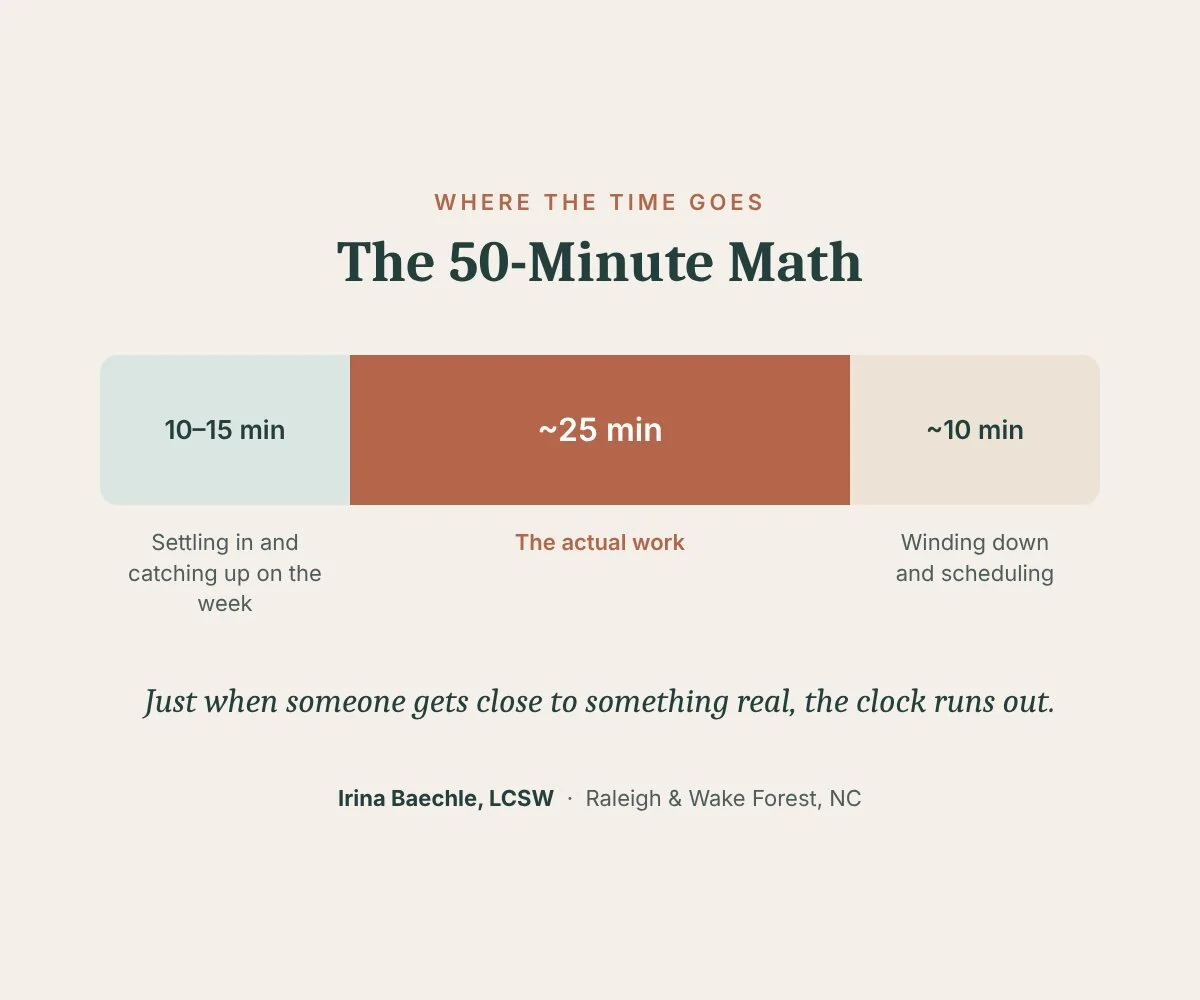
Let’s look at where the time actually goes.
You arrive, get settled, and put your phone away. That’s a few minutes. Then comes the catch-up: how was your week, what happened, did the fight happen again. That’s another 10 to 15 minutes, and it has to happen every single session because a week is a long time and a lot has piled up.
The last 10 minutes or so go to wrapping up. A good therapist doesn’t send you out the door in the middle of a wide-open emotional moment, so there’s some landing time, plus scheduling and a recap of homework.
So what’s left for the actual work? Maybe 25 minutes. Between two people. In the middle of a Wednesday.
And that’s before you count the drive there, the drive back, and the meeting you rushed to make it to afterward. For a lot of couples, therapy time is squeezed between drop-offs, pickups, lunch, and work. It’s hard to drop down into something vulnerable when you’re watching the clock and calculating whether you can make your 1:00.
When couples come to me after weeks or months of weekly therapy, I hear the same things. It felt like always running out of time. They felt a little better, but never got to the bottom of anything. There wasn’t enough progress, nothing stuck, and a lot of the time it was rehashing the same old argument without a resolution. Everything felt rushed, and some of them walked away thinking therapy just doesn’t work.
The “Almost There” Problem
Here’s the part that frustrates me most about the 50-minute format.
Real change in couples work happens underneath the fight. The fight is the symptom. I tell my couples that conflict is just the inflammation, and the emotional disconnection is the virus. You can talk about the inflammation all day, but the shift happens when one of you gets to the fear or the hurt that’s driving it: “I get so scared when you pull away that I panic and start criticizing.”
That kind of moment doesn’t happen on command. It takes time to get there. We slow things down, we track what’s happening in your body, we get underneath the surface. And just when someone gets close, the clock runs out.
It’s like heading up a mountain and turning around 50 feet from the summit every single week because it’s getting dark. You’ve done most of the climbing. You never get the view. And the next week you start from the bottom again.
That’s what I mean by “almost there.” Couples in weekly therapy live in it for months, sometimes years. They learn a lot about their problems. They can describe their cycle in their sleep. But they can’t stop it when it counts, because they’ve never had enough uninterrupted time to feel something new with each other and let it settle in.
Here’s another version of “almost there” that I see a lot in my office. Say we do have time to unpack the argument. We understand where each of you is coming from, and each of you gets to share it with the other, which matters a lot for a corrective emotional experience. That’s real progress. And then the clock runs out, and you’re left with the question nobody has time to answer: okay, now what do we do with this? How do we carry it between now and the next session? In 50 minutes, we barely scratch the surface of what happened and how to understand it differently, let alone the practical part. In a retreat, we have time for that part too. We understand the cycle and the steps each of you takes in the dance, and then we practice new steps. We talk about how to track the cycle outside the office, set up daily check-ins, and map out what all of this looks like in real life.
What It Costs You
When weekly therapy stalls, the cost isn’t just the session fee, though that adds up fast. Here’s what couples tell me they’re really paying.
Time. An hour a week, plus the commute, plus the mental energy of preparing and recovering. Over a year, that’s a lot of hours spent on a process that moves in tiny steps.
Money. Weekly sessions over many months or years can add up to more than a focused, intensive format would cost. And if you’re still in the same place after all of it, that’s hard to swallow.
Hope. This one matters most. When you’ve been in therapy for a year and nothing feels different, it’s easy to decide that the problem is you, your partner, or the relationship itself. Many couples quit at exactly this point, convinced that therapy doesn’t work for them, when what didn’t work was the format.
Years. Most couples wait years before they seek counseling at all. Add more years of slow-moving weekly sessions on top of that, and that’s a lot of years of living with a disconnection that could have started healing much sooner.
What Changes With More Time
This is why I stopped offering weekly sessions and moved my practice to couples retreats.
A retreat is a full day of focused couples work in my office. New couples start with a 2-day retreat, then continue with a 1-day retreat once a month for 12 months or longer. A typical day runs about five hours of sessions plus a one-hour lunch: time together, an hour with each partner individually, lunch, and a longer stretch together to make sense of everything.
Here’s what that extra time makes possible:
No catch-up tax. You’re not spending the first 15 minutes on your week. We start with what matters.
No cliffhangers. When something big opens up, we stay with it. Nobody says “see you next Thursday” in the middle of your breakthrough.
Room to feel, not just talk. You can slow down, take a breath, and go somewhere vulnerable without watching the clock. If one of you needs 10 minutes of quiet before you can say the true thing, we take 10 minutes.
Fewer transitions. You aren’t squeezing therapy between pickups and meetings. You step away from the phones, the kids, and the busyness for the day, and that makes a real difference in how deep you can go.
And the month between retreat days isn’t empty. You practice what we worked on with exercises and homework, you get customized audio messages with affirmations and what we learned, and there are optional 75-minute check-in sessions if something comes up and you need support. Then the next retreat day builds on the last one.
In my experience, one retreat day gets couples further than weeks of weekly sessions.
I go into the full picture in my guide to why a couples retreat gets you further than months of weekly sessions.
Weekly Sessions Still Have a Place
I’ll be honest: weekly therapy isn’t useless, and a retreat isn’t for everyone.
Weekly sessions can be a good fit if you want lighter support, if you’re not ready to commit a full day, or if you’re working on something small and specific. If you’re in a place where you’re not sure you want to stay in the relationship, weekly sessions can offer a lower-stakes way to explore that.
I don’t offer weekly sessions in my practice anymore. That’s a choice I made because the retreat format gets the results I want for my clients, not a judgment on everyone else. If weekly is what fits your life right now, I’m happy to refer you to therapists I trust and whose clinical expertise I know. Some of their couples come to me for a deep-dive retreat when they need one, then go back to their weekly therapist. And whoever you choose, here are questions worth asking:
What training do you have in couples work, and what method do you use?
How do you handle it when a session ends in the middle of something big?
What does progress look like after three months, and how will we know it’s happening?
And if you’ve been doing weekly work for a year or more and you still feel stuck, that’s worth paying attention to. It doesn’t mean you failed. It might just mean the format isn’t giving you what you need.
One more thing: a retreat isn’t for couples with active, ongoing abuse, an active affair, or active addiction, and it isn’t a good fit if you’ve already checked out and are only doing this for the kids. It works when you both still care, even if that feels faint right now.
About Irina Baechle, LCSW

Hi, I’m Irina Baechle, a licensed clinical social worker and marriage therapist in Raleigh and Wake Forest, NC. For more than 15 years, I’ve helped couples move out of painful, stuck places and back toward each other.
I’m trained in Emotionally Focused Therapy (EFT), the most research-backed approach I know for healing emotional distance and rebuilding trust. When it’s appropriate, I also use brainspotting and ketamine-assisted psychotherapy to expedite results. I’ve offered couples retreats since 2017, and today it’s the only way I work: a 2-day start in my cozy private office in downtown Wake Forest, then monthly 1-day retreats for 12 months or longer. You can read the full picture in my guide to why a couples retreat gets you further than months of weekly sessions.
I believe in the power of healthy relationships, and I want healthy, trustworthy marriages to be the norm, not the exception. I’m direct, I’m warm, and I’ll tell you what I see without shame.
Topics I write about include marriage, infidelity, roommate marriages, sexless marriage, ketamine-assisted psychotherapy, healthy second marriages, and healing after toxic or unfaithful marriages.