You’ve been showing up to weekly marriage counseling for a few months now. The sessions are decent. Maybe one of them was even great, and you drove home feeling closer than you have in a long time. Then Thursday rolls around, one of you says the thing, the other one shuts down, and you’re right back in the same fight you’ve been having for years.
So you start wondering what’s wrong. Is it us? Is it me? Are we just bad at this?
Here’s my honest take after years of doing this work: very often it’s not you, and it’s not your relationship. It’s the format. Fifty minutes once a week was never built for the kind of deep emotional work that actually changes how two people connect.
If you’re searching for marriage counseling Raleigh NC and you’re tired of spinning your wheels, this post walks you through a different way of doing it, why it’s the only way I work now, and how to tell if it’s right for you.
What a Couples Retreat Actually Is (and Isn’t)
When I say couples retreat, I don’t mean a weekend at a resort or a workshop where you sit in a circle with strangers. I mean a full day of focused couples work in my office. Just the two of you and me.
Here’s the structure. New couples start with a 2-day retreat. After that, we move to a 1-day retreat once a month, for 12 months or longer. (Some couples who are in crisis or need answers faster come more often, sometimes weekly. More on that below.)
A typical day is about five hours of sessions plus a one-hour lunch, and it goes like this:
We start with a grounding exercise or a short meditation so you can actually land in the room instead of arriving straight from traffic and email.
Together, 1 hour. We explore your relationship history and what’s bringing you here.
Partner A, 1 hour, then Partner B, 1 hour. Individual sessions where each of you explores your own experience more deeply.
Lunch, 1 hour. Time to rest, refuel, and connect. Yes, a real one.
Together, 2 hours. We make sense of what you’ve discovered and start creating new ways of connecting, then wrap with a recap of what worked, what didn’t, and what we learned. Sometimes we close with a meditation.
If you want the play-by-play, I wrote a whole post on what happens during a couples retreat in North Carolina.
I’ve offered retreats since I started my private practice in 2017. I kept watching couples get more out of a full day than they ever did out of months of weekly sessions. Two years ago I finally took the leap and stopped offering anything else, because retreats produced the best clinical outcomes I’d seen. Here’s the longer story. For years I offered retreats on the side, maybe one or two a year, for couples who were curious. Almost nobody knew what a couples retreat was back then, and it definitely wasn’t as cool as it is today. But the results kept surprising me, so I started requiring every couple to jump-start their work with a full 6-hour retreat day before we moved to weekly sessions. Then, about two years ago, several couples told me some version of “wow, this is such an amazing format,” and something clicked. The therapy wasn’t wrong, and the therapist wasn’t wrong. The format was. Weekly sessions were too rushed and not deep enough to go where couples needed to go. I decided I didn’t want to deliver mediocre outcomes. I wanted the best outcomes possible, so I went all in.
The Problem With 50 Minutes a Week
Let’s do the math on a weekly session.
The first 10 to 15 minutes go to settling in and recapping the week. The last 10 go to winding down, scheduling, and getting you ready to walk back out into your life. That leaves maybe 25 minutes of real work in the middle.
And here’s the cruel part. Right about when one of you gets close to something vulnerable, the thing underneath the anger, the fear you’ve never said out loud, the clock runs out. “We’ll pick this up next week.” Then you walk out and go straight to school pickup, or a work meeting, or the grocery store. You’re raw, you’re interrupted, and you’ve got seven days before anyone helps you finish the thought.
It’s like starting surgery, getting the patient open, and then saying, “Sorry, we’re out of time, come back Tuesday.” (That one’s a little dramatic. But you get it.)
This is why so many couples I meet have been in weekly therapy for months, even years, and feel like they’ve learned a lot about their problems without actually changing anything. I dig into this more in why 50 minutes a week isn’t enough.
Here’s a version of something that happens all the time. A partner tells me about a brutal argument and how far apart the two of you feel. I want to stay right there with them. I want to say, “That makes sense to me. Tell me more,” and keep resonating until they feel fully heard, because most of us need to be heard and validated before we can take in anything else. Then I can help them put it into words their partner can actually receive, without pushing the partner away. But in 50 minutes, I don’t have that time. I have to say, “I know you have more to say, but we’re running out of time. Can I hear from your partner?” And that doesn’t make for good therapy.
Why Knowing Better Doesn’t Mean Doing Better
Most couples come in thinking they need better communication skills. I get it. “I statements,” calm tone, reflective listening. None of it is wrong, and it can be genuinely useful in a conversation with your boss or your child’s teacher.
But how many of you are smart, accomplished people who know exactly what you should say, and then it all goes out the window the second you’re in battle mode with your partner? Yeah. Me too, in my own marriage.
That’s not a character flaw. When you feel threatened by the person you love most, your nervous system takes over, and the skills you learned in a calm office stop being available. Research on communication-skills training points the same way: couples who learn these skills often don’t end up much better off long term than couples who never learned them.
Here’s how I explain it to my couples. The fight is just the inflammation. The virus is the emotional disconnection underneath it. You can keep treating the inflammation with better phrasing and calmer voices, and you might feel 20 or 30 percent better. But if you don’t treat the virus, you stay stuck right there.
Treating the virus means getting to the fear, the hurt, and the needs under your usual cycle: the pursuing, the withdrawing, the shutting down, the getting loud. That’s the work in Emotionally Focused Therapy (EFT), the approach I’m trained in, which is built on decades of research on love and attachment. And that kind of work needs time. A lot more of it than 25 minutes in the middle of a Wednesday.
What a Full Day of Focused Work Makes Possible
When you have a whole day, everything changes.
You can go deeper without stopping and restarting
Nobody has to rush through a hard conversation. If one of you needs ten minutes of silence before you can say the true thing, we take ten minutes. If something big surfaces, we stay with it instead of tucking it away until next week.
You get to the cycle, the emotions underneath, and the needs, all in one sitting
In a full day, we can map your cycle, slow it down, move underneath it, and then practice something new in the room, with me right there. That’s a different thing than hearing about a new skill and trying to use it alone at 9 p.m. when you’re both exhausted.
You leave with clarity and hope
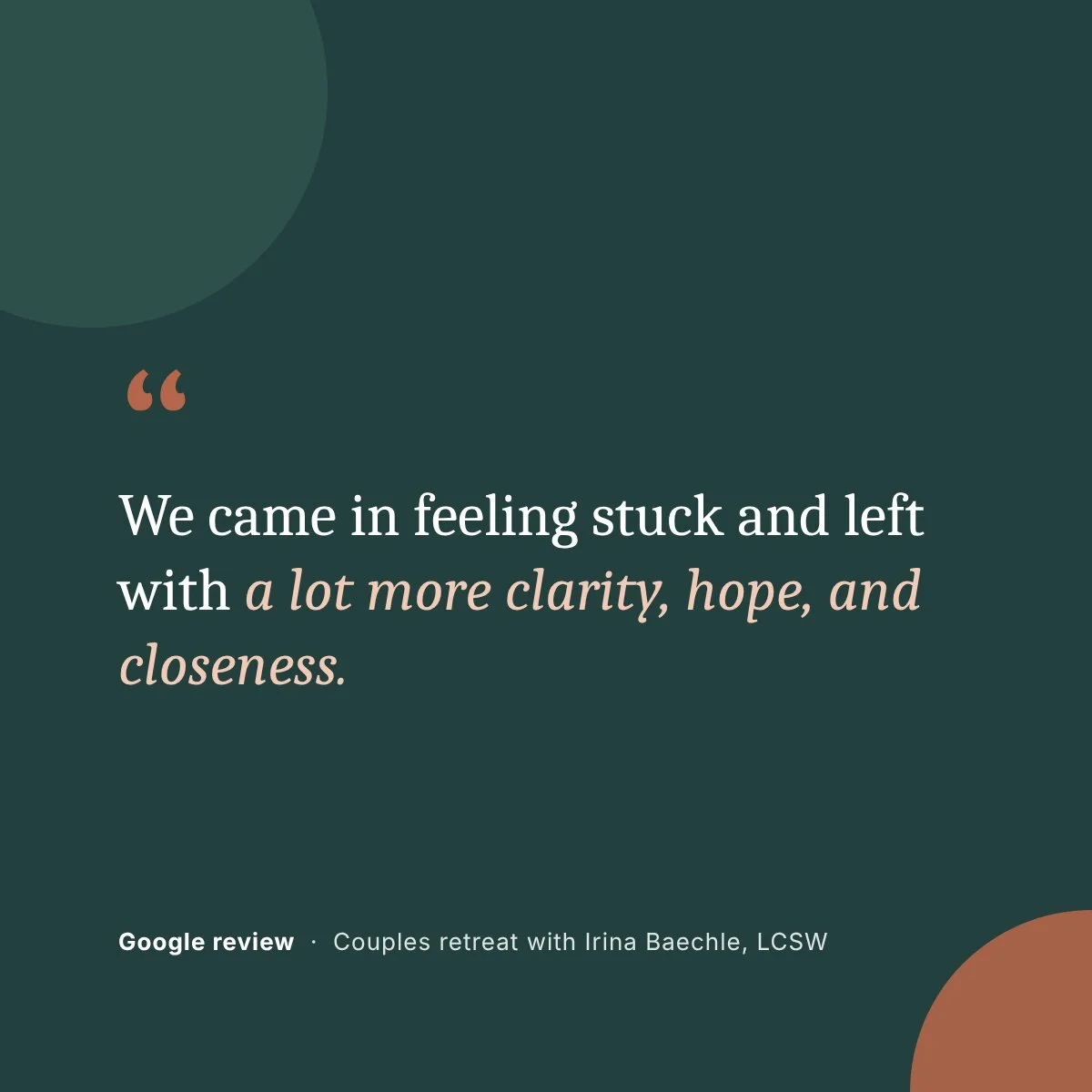
This is the part I hear most. After a day of focused work, couples walk out understanding what’s actually going on between them, and understanding that it’s not because one of them is broken or doesn’t care. They have a plan. And a lot of them say some version of “We wish we’d done this years ago.” One couple put it this way in a Google review: “We came in feeling stuck and left with a lot more clarity, hope, and closeness.”
Why we start with two days
New couples start with a 2-day retreat because the first stretch builds the foundation: your story, your history, your cycle, your attachment patterns, and enough safety between the two of you to go to the harder places. Everything we do afterward stands on that.
Why Monthly Retreats Work: Intensity Plus Integration
Here’s a fair question. If I’m saying a week is too long between weekly sessions, why does a month work for retreats?
Because the two formats are doing completely different jobs.
A retreat day gives us enough time to create what I call corrective emotional experiences: moments where the two of you actually feel something shifting together, in real time. And we get repetition. When you go through those experiences again and again, your brain and your nervous system, especially your emotional, limbic brain, start to learn them. That repetition is what makes new patterns stick instead of fading by Thursday.
The month in between isn’t downtime. It’s integration. You get:
Exercises and homework to practice what we worked on (yes, I assign homework, and yes, I’ll call you out if you skip it)
Customized audio messages with affirmations and the things we’ve learned, so you can keep listening to them between retreat days
Optional 75-minute check-in sessions if something comes up and you need to troubleshoot
Then the next retreat day builds on the last one. It’s scaffolding. Each month adds a layer on top of the one before, and consistency is what keeps you from sliding back into old patterns. I wrote more about this in why progress doesn’t stick with a week between sessions.
Why 12 months or more?
Because rewiring the brain and nervous system takes time. If your patterns took years to form, and for most of us they started in childhood, a few weeks of effort won’t undo them. Twelve months of monthly retreats gives your system enough repetitions to actually feel safe with each other in a new way, not just understand it.
It’s case by case, too. Some couples want to move faster. They’re in crisis, or they need answers sooner, or they simply want to feel better sooner. For them, we might do a full day every week, or twice a week, or several retreat days within a single month. We build the pace around where you are.
What couples notice along the way
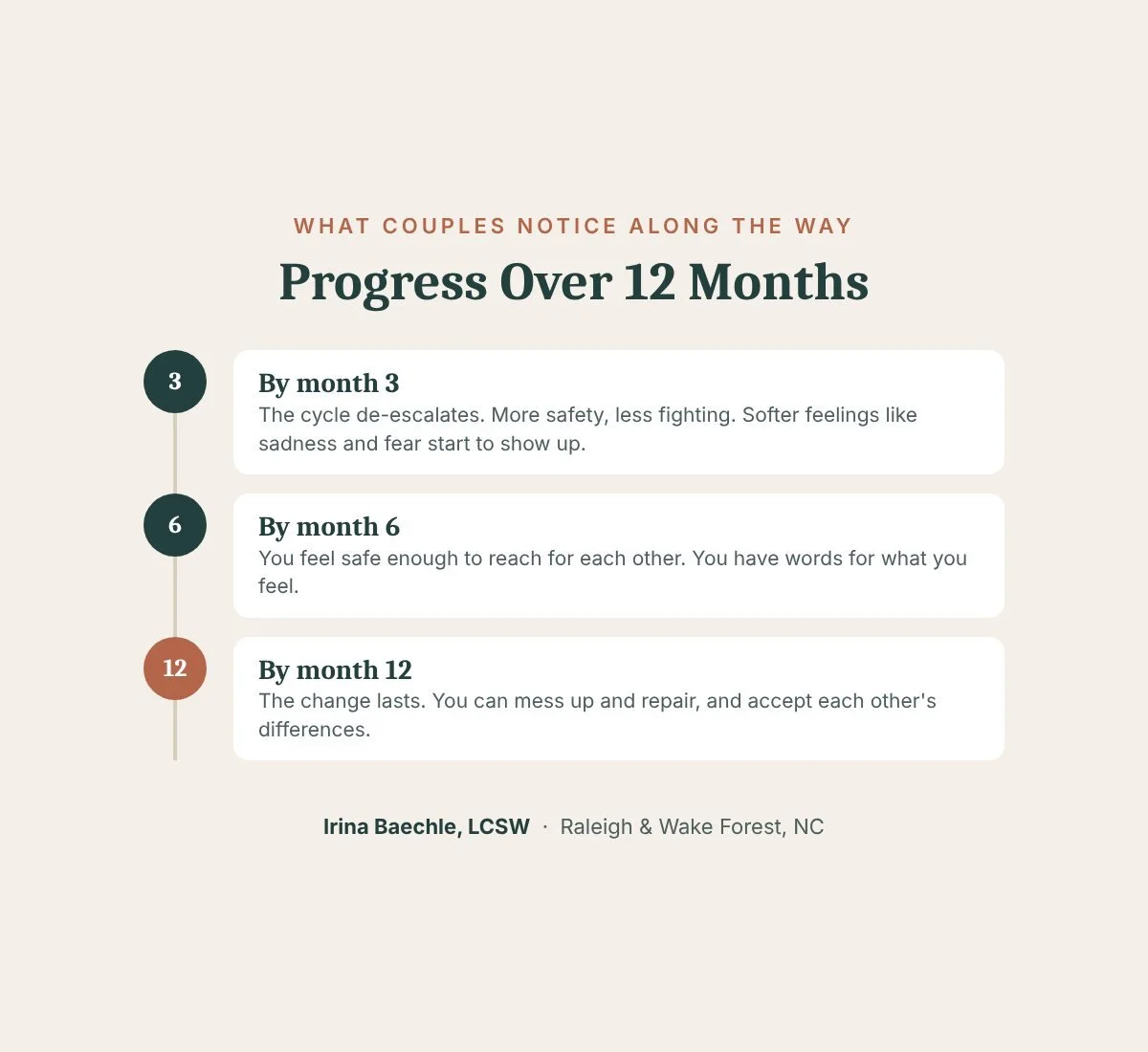
Every couple moves at their own pace, but here’s what I tend to see:
By month 3: The cycle de-escalates. There’s more safety, less fighting, and less arguing. Softer, more vulnerable emotions like sadness and fear start to show up, not just anger and frustration.
By month 6: Couples feel safe enough to reach for each other in ways they couldn’t before. They have language for how they feel and more awareness of their own inner world.
By month 12: After many repetitions of new emotional experiences, the change is sustained. Couples aren’t just arguing less. They feel safe enough to mess up and repair, and they can see that some of what they’ve been fighting about has nothing to do with their partner. They can tolerate their own emotions, hold their own experience and their partner’s at the same time, and there’s real acceptance of each other’s differences, including neurodivergent ones.
When EFT Isn’t Enough: Brainspotting and Ketamine Therapy
EFT is powerful, and for many couples it’s all we need. But sometimes, especially with complex trauma or deeply held pain, talk therapy, even experiential talk therapy that works from the bottom up, doesn’t get us all the way there. When we get stuck, I bring in other tools. Here are two.
Brainspotting
Brainspotting is a way of working with the deeper, subcortical parts of the brain, where a lot of trauma gets stored, so we can process and rewire it. Partners can find their brain spots at the same time, together in the room, which can be powerful. We might do it in the middle of a retreat day if it’s what the moment calls for.
Ketamine therapy
When both EFT and Brainspotting haven’t been enough, ketamine therapy is another option. I work with a prescriber who does a full medical evaluation and clears each person first. Then you bring your medication with you, and we do the session in my office. It isn’t where we start, it isn’t right for everyone, and it only happens after that medical clearance. Sessions use eye shades and headphones, and I weave in EFT and sometimes brainspotting to help you put words and meaning to what comes up.
If you’re curious about either, we can talk about it on a consultation call.
Who Tends to Benefit Most
A retreat tends to be a great fit if you:
Feel stuck in the same cycle no matter what you try
Have already done weekly couples therapy and feel like you’re running in place
Are recovering from a rupture like an affair that has fully ended
Have busy lives and can’t keep squeezing 50 minutes in between everything else
Want to start rebuilding connection now, not in two years
Neurodivergent partners
This format is especially helpful when one or both of you has ADHD or another way of processing that makes transitions hard. Think about what a weekly session really asks of you: drop-offs, pickups, lunch, a quick drive, and then straight into a work meeting. It’s hard to descend into the deep, vulnerable stuff when you have to switch gears three times before and after.
A retreat day is your own day, at your own pace. Fewer transitions, fewer distractions, fewer things to keep track of. That leaves more room to focus on each other. I wrote about this in more detail in couples therapy for neurodivergent partners in Raleigh NC. We take as many breaks as we need, including extra stretch and bathroom breaks. After lunch, when some couples get sleepy, I have thick mats, pillows, and bolsters so you can lie down and close your eyes. I keep plenty of fidgets on hand, and at the start of the day we name your stressors and triggers so we can make room for them.
Who a Retreat Is Not For
I’d rather be honest with you than take your money. A couples retreat is not the right fit if:
There is active, ongoing abuse
There is an active, ongoing affair
There is active, ongoing addiction
This is a last-ditch effort, where you’ve already decided you don’t love each other and you’re only here for the kids
There’s so much hostility or contempt that you can’t be in the room without being cruel to each other
If any of those are true, other support needs to come first. And if you’re not sure where you fall, that’s a good thing to bring to a consultation call.
“We Wish We’d Done This Years Ago”
Most couples I meet wait years before they get help, often far longer than they wish they had. That’s a lot of lonely dinners, a lot of resentment, and a lot of the same fight on repeat.
It’s the one regret I hear most from couples: not starting sooner. You don’t have to be on the brink of divorce to benefit from this. You just have to be tired of feeling disconnected. I talk about this more in why most couples wish they’d done a couples retreat in North Carolina years ago.
A fellow therapist who refers couples to me said it well in a Google review: my flexible intensive sessions “will help you resolve those recurring issues in your marriage without months and months (or years!) of but-we-were-just-getting-somewhere! one-hour appointments.”
Couples Retreat or Weekly Sessions? How to Decide
Both have a place. Weekly sessions can work well for couples who want lighter support, who aren’t ready to commit a full day, or who need to get something stable first. A retreat tends to be the better fit when you want deep change, you’re stuck, or you want to move faster than the weekly pace allows. I don’t offer weekly sessions myself, so if weekly is what fits right now, I’ll refer you to therapists I trust and whose clinical expertise I know. Some couples use both: they keep a weekly couples therapist and come to me for a deep-dive retreat when they need one, then go back to their weekly therapist.
A couple of practical things to know:
Cost: A retreat day is $3,500, so your 2-day start is $7,000. Insurance doesn’t cover it. That’s a real investment, and it’s worth comparing to what you’d spend on months of weekly sessions without lasting change.
Training: Whoever you choose, ask what training they have in couples work and what method they use. I’m trained in EFT.
Fit: Ask how they handle trauma if it comes up, since most of us have some.
If you’re weighing the two, my guide to choosing between a couples retreat and weekly marriage counseling in Raleigh NC walks through it step by step.
About Irina Baechle, LCSW
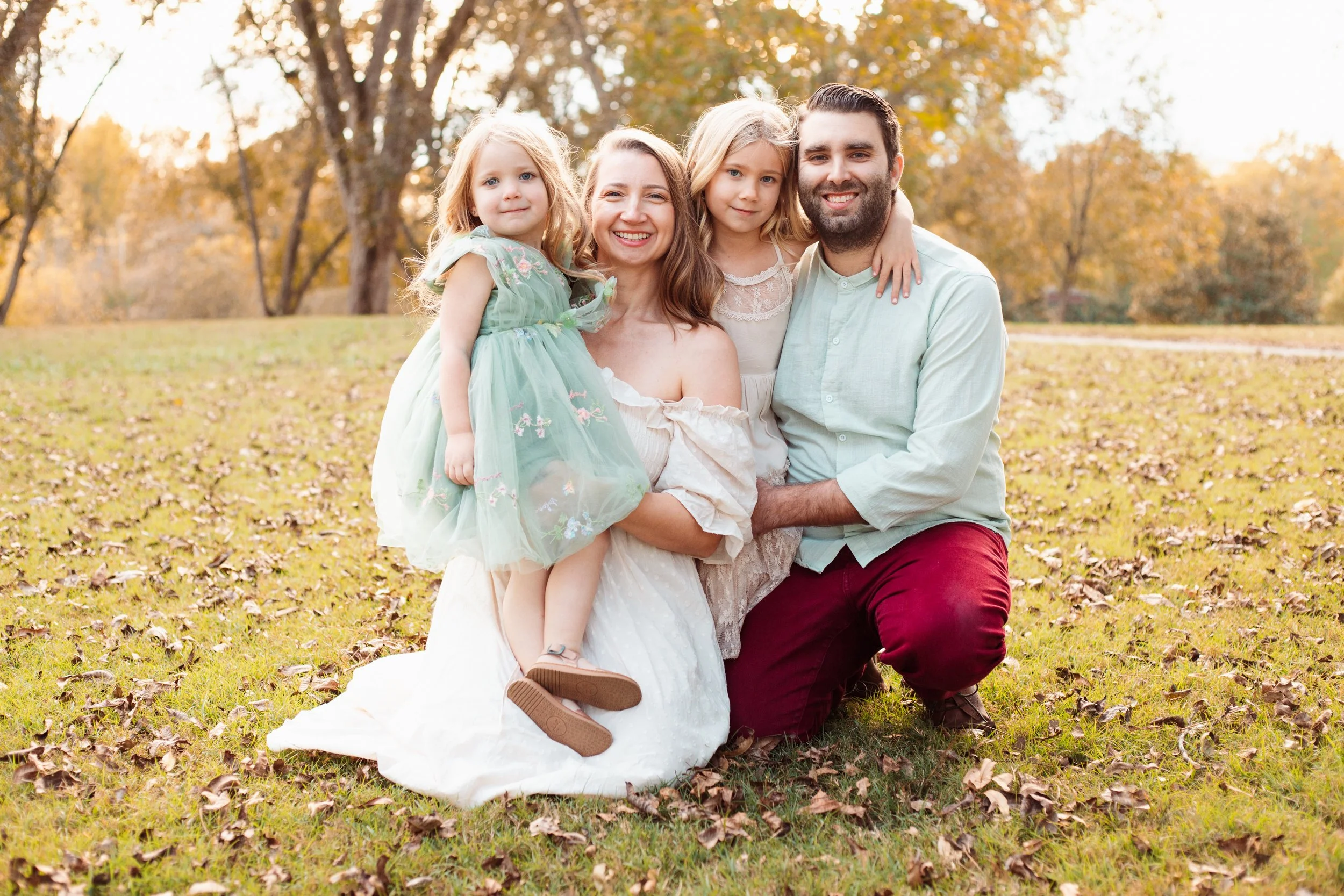
Hi, I’m Irina Baechle, a licensed clinical social worker and marriage therapist in Raleigh and Wake Forest, NC. For more than 15 years, I’ve helped couples move out of painful, stuck places and back toward each other.
I’m trained in Emotionally Focused Therapy (EFT), the most research-backed approach I know for healing emotional distance and rebuilding trust. When it’s appropriate, I also use brainspotting and ketamine-assisted psychotherapy to expedite results. I’ve offered couples retreats since 2017, and today it’s the only way I work: a 2-day start in my cozy private office in downtown Wake Forest, then monthly 1-day retreats for 12 months or longer.
I believe in the power of healthy relationships, and I want healthy, trustworthy marriages to be the norm, not the exception. I’m direct, I’m warm, and I’ll tell you what I see without shame.
Topics I write about include marriage, infidelity, roommate marriages, sexless marriage, ketamine-assisted psychotherapy, healthy second marriages, and healing after toxic or unfaithful marriages.