
It's Wednesday. You've done school drop-off, jumped on a work call, wolfed down lunch in the car, and driven across town in traffic. Now you're sitting on a therapist's couch, and you're supposed to open up about the most painful thing in your marriage. In 50 minutes. And then get right back in the car for your 2:00 meeting.
For anyone, that's a lot. For a brain with ADHD, it can be close to impossible.
In most of the couples I work with who are struggling with this, at least one partner has ADHD. And many of them come to me after weekly therapy that just didn't work for them. If that's you, I want you to know that you're not bad at therapy. The format just wasn't built for how your brain works.
That's a big part of why my approach to marriage counseling in Raleigh NC looks the way it does.
When Weekly Therapy Isn't Built for Your Brain
Think about what a weekly session really asks of you. Drop-offs, pickups, lunch, a quick drive, and then straight into a work meeting. You have to switch gears three times before you even sit down, and three more times after you leave.
Transitions are hard for ADHD brains. So is focusing on command, on a clock, after a morning that already used up most of your attention. It's hard to descend into the deep, vulnerable stuff when part of you is still in the last meeting and part of you is already worrying about the next one.
And then, right when you finally settle in and start to feel something real, the session is over. If you want the full math on that, I break it down in why 50 minutes a week isn't enough.
How ADHD Shows Up in a Couple's Cycle
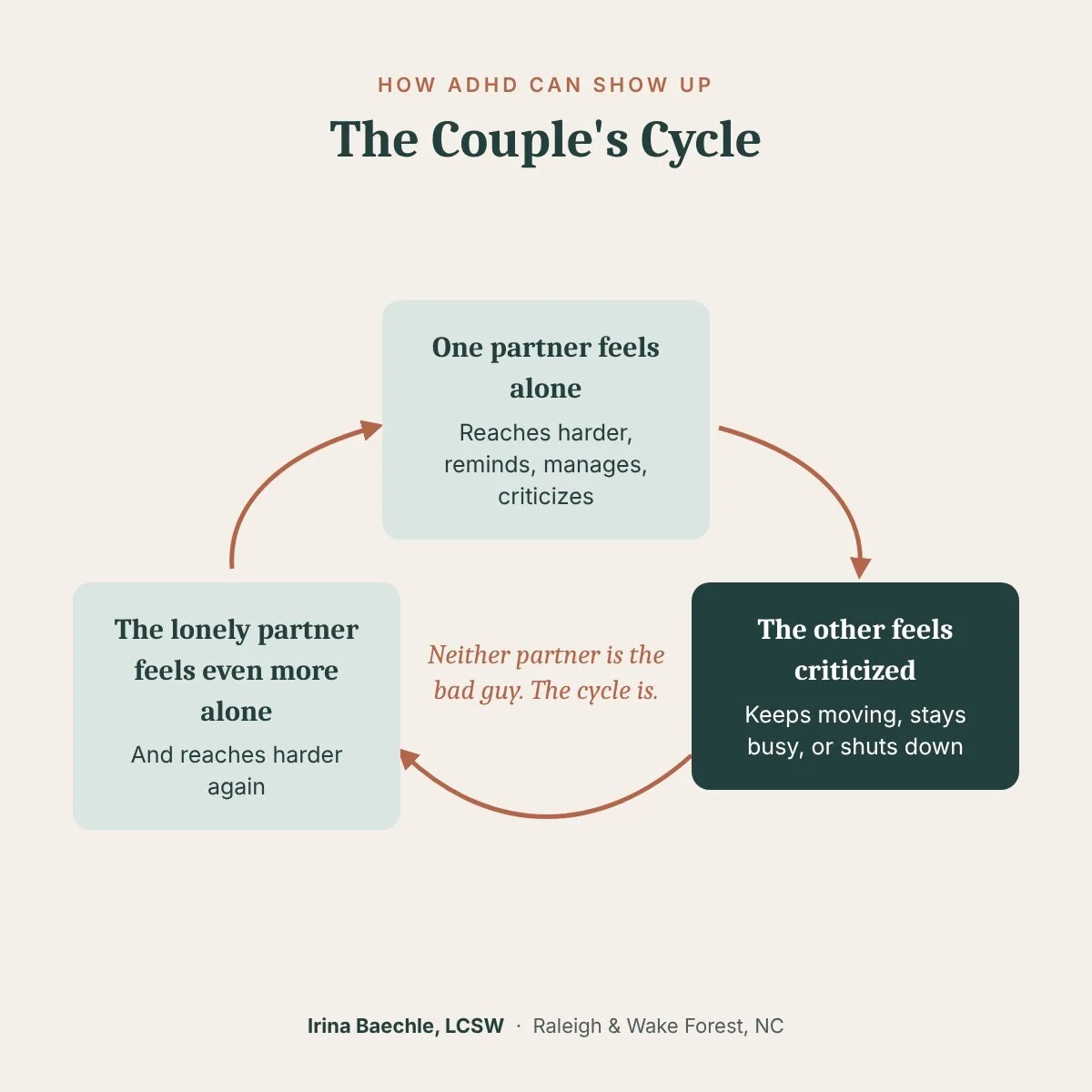
Every couple has a cycle, the emotional dance you fall into when you feel disconnected. When one partner has ADHD, that cycle often has a very particular shape.
One partner feels alone
One of you feels alone, unloved, and unheard. You want to spend more time together. You want your partner to slow down and actually listen to you, without checking their phone, answering an email, or getting up to fix something halfway through the conversation.
Over time, you end up in the manager role. You're the one reminding, organizing, tracking, and asking. And underneath all that managing is a lot of loneliness. Do I even matter to you?
The other partner can't stop moving
The other partner has ants in their pants. They never stop. They're always working, always going, always doing the next thing. Slowing down feels almost physically uncomfortable, and listening without doing something else at the same time is really, really hard.
From the outside, it can look like they don't care. From the inside, it usually feels completely different.
And around and around it goes
The lonely partner reaches harder and gets more critical. The busy partner feels criticized and keeps moving, or shuts down. Which makes the lonely partner feel even more alone. Neither of you is the bad guy. The cycle is.
"ADHD Is Just an Excuse" (It Isn't)
This is the misconception I want to push back on the most. I hear versions of it all the time: ADHD is just an excuse. Or: They'd do it if they really loved me.
ADHD is not an excuse. It's a real thing. And here's what I tell my couples: the brain doesn't do anything randomly. There is always a good reason behind what we do, even when that reason isn't obvious from the outside.
So it's not something a partner can simply overcome on their own by trying harder or loving you more. But here's what does help: empathy. When your partner understands where you're coming from, whether it's ADHD, exhaustion, or anything else, you feel safer with them. And when you feel safer, everything in the relationship gets easier to work on.
Many of my couples have one partner with an official ADHD diagnosis, and some take medication for ADHD, depression, or anxiety. Sometimes it helps, and sometimes it doesn't. We look at how it's working for the two of you together, but I won't tell you what to do about medication. That's your call to make with your prescriber. My focus is the relationship.
Why a Full Day Works Better
This is where the retreat format really shines for neurodivergent couples.
Fewer transitions
A retreat day is your own day, at your own pace. One place, one day, no gear-switching between pickups and meetings. Fewer transitions, fewer distractions, fewer things to keep track of. That leaves a lot more room to focus on each other.
We can see the cycle happen in real time
Let me tell you about a couple I worked with who had exactly the pattern I described above. She felt alone and unheard. He never stopped moving and struggled to listen without being busy with something else.
In a 50-minute session, we could talk about that pattern. In a full day, we had enough time to watch it happen right there in the room, in the present moment.
So when it happened, I named it. His wife confirmed it: "Yes. That. That's what it feels like at home." And because we weren't rushing, he had time to actually see it, and to see how his busyness was feeding their cycle. Not as an accusation, but as something he could finally notice.
Then we tried something different. He slowed down. And when he did, the whole dynamic between them changed. She softened, he felt less criticized, and they could actually hear each other.
That kind of moment needs time. It needs room to notice, name, slow down, and try again. That's very hard to fit into 50 minutes.
Time to slow the whole cycle down
With the lonely, managing partner, my work is about slowing everything down, staying in the present moment, and building safety between the two of you. Together we figure out how each of you can send a safety signal that actually lands for your partner, in the way that works best for them.
How I Adapt the Day for Neurodivergent Couples
I don't expect your nervous system to fit my schedule. We build the day around you.
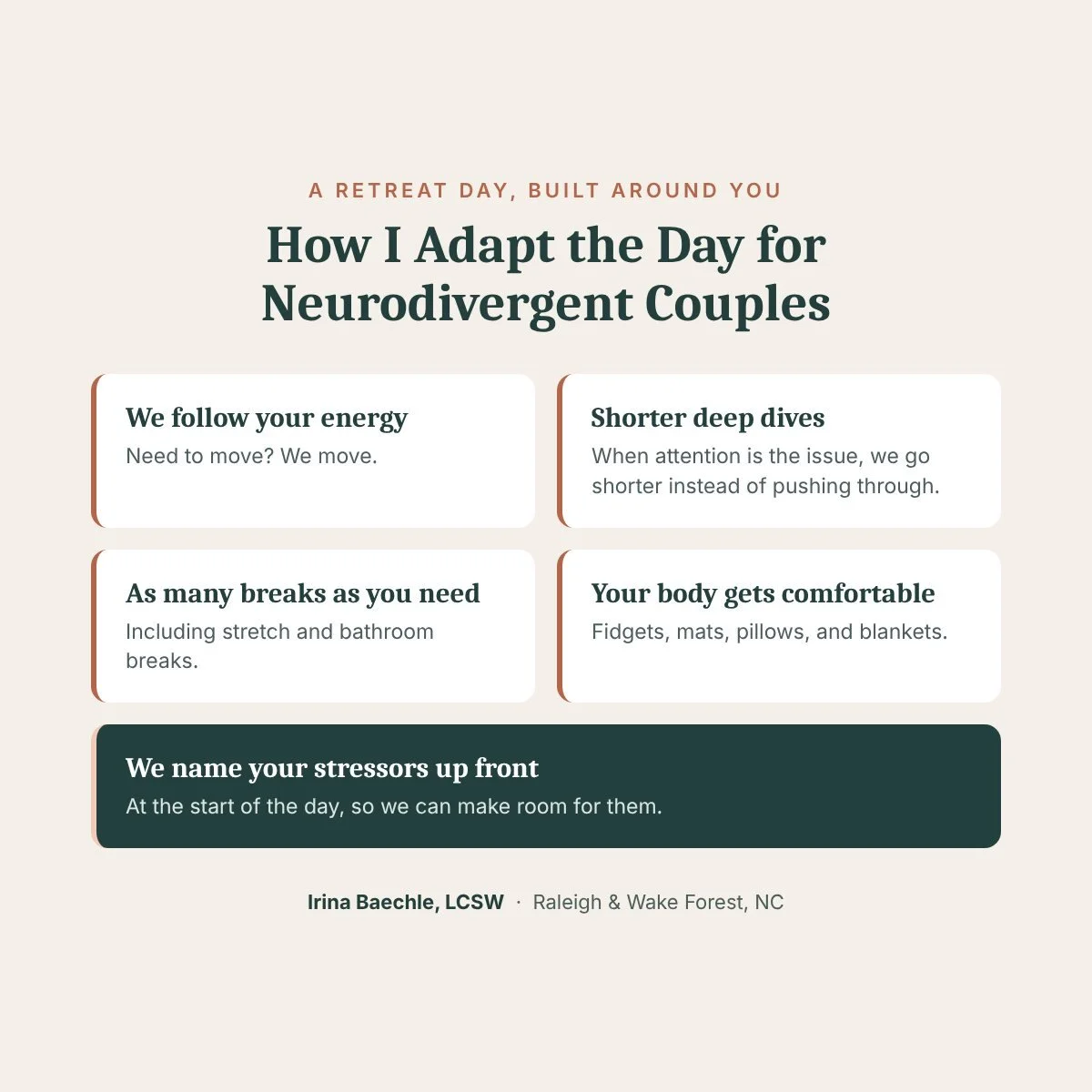
We follow your energy. If you need to move your bodies, we move. If attention is spent and focus is gone, we take a break.
We go shorter when we need to. If attention is the issue, we do a shorter deep dive instead of pushing through.
We take as many breaks as you need, including extra stretch and bathroom breaks.
Your body gets to be comfortable. I keep plenty of fidgets on hand. After lunch, when some couples get sleepy, I have thick mats, pillows, and bolsters so you can lie down and close your eyes.
We name your stressors up front. At the start of the day, we talk about your stressors and triggers so we can make room for them instead of being surprised by them.
I walk through a whole retreat day, hour by hour, in what actually happens during a couples retreat in North Carolina.
Between Retreat Days
The month between retreats has a structure that tends to work well for ADHD brains. Instead of long assignments, you get short daily check-ins (just five minutes at first) and customized audio messages you can listen to on the go. You hear what we learned together, over and over, which is exactly how new patterns start to stick.
I explain why that repetition matters so much in why progress doesn't stick when there's a week between sessions.
Is a Retreat Right for You Two?
A retreat tends to be a great fit if:
One or both of you has ADHD, or another way of processing that makes transitions hard
Weekly sessions have felt rushed, scattered, or impossible to focus in
One of you feels alone and the other feels criticized, and you keep landing in the same fight
You're both tired of blaming each other and want to understand what's really going on
The goal isn't to turn one of you into a different person. It's for both of you to understand each other, feel safe with each other, and accept your differences, including the neurodivergent ones. I lay out the full approach in my guide to why a couples retreat gets you further than months of weekly sessions.
About Irina Baechle, LCSW

Hi, I'm Irina Baechle, a licensed clinical social worker and marriage therapist in Raleigh and Wake Forest, NC. For more than 15 years, I've helped couples move out of painful, stuck places and back toward each other.
I'm trained in Emotionally Focused Therapy (EFT), the most research-backed approach I know for healing emotional distance and rebuilding trust. When it's appropriate, I also use brainspotting and ketamine-assisted psychotherapy to expedite results. I've offered couples retreats since 2017, and today it's the only way I work: a 2-day start in my cozy private office in downtown Wake Forest, then monthly 1-day retreats for 12 months or longer. You can read the full picture in my guide to why a couples retreat gets you further than months of weekly sessions .
I believe in the power of healthy relationships, and I want healthy, trustworthy marriages to be the norm, not the exception. I'm direct, I'm warm, and I'll tell you what I see without shame.
Topics I write about include marriage, infidelity, roommate marriages, sexless marriage, ketamine-assisted psychotherapy, healthy second marriages, and healing after toxic or unfaithful marriages.