
"Will this even work?"
"Is it too late for us?"
These are the two questions I hear most from couples before their first retreat day. And right behind them: "Six hours? What are we even going to talk about for six hours?" and "What if we just fight the whole time?"
If you're feeling some version of that right now, it makes total sense. A full day of couples therapy is a big step, and it's hard to say yes to something when you can't picture it.
So let me walk you through it. From the first phone call to the drive home, here's exactly what happens during a couples retreat in my office, and how it fits into my approach to marriage counseling in Raleigh NC.
Before Your First Retreat Day
A free consultation call
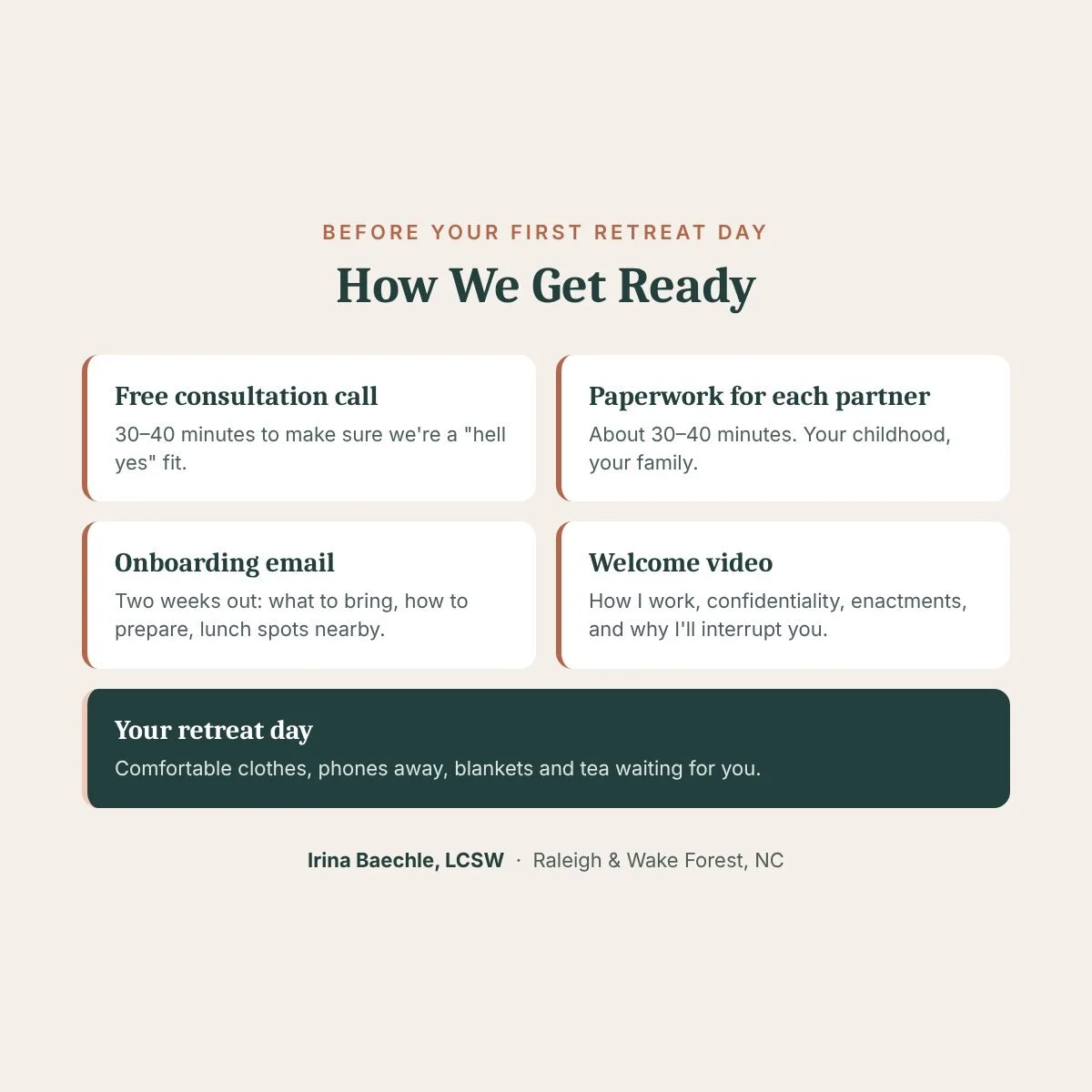
It starts with a free 30 to 40 minute phone consultation. I'll ask you what brings you here, what the last straw was, and what you want to see change. I'll tell you how I work and how I can help.
I also screen carefully. Most couples stay with me for over a year, so I want to be sure this is a "hell yes" for everyone involved, including me. If I'm not the best person to help you, I'll tell you, and I'll point you to someone who is.
Paperwork for each partner
Once we decide to work together, each of you gets your own paperwork. It takes about 30 to 40 minutes, and it asks about things like your childhood and your family. This means we don't spend precious retreat time on basic history.
An onboarding email and a welcome video
About two weeks before your retreat, I send an onboarding email that covers what to bring, what to think about ahead of time, how to prepare, and your options for lunch near my office.
I also send an optional 30 to 40 minute video for new clients. In it, I cover confidentiality, how I work, my cancellation policy, and what happens if one of you gets sick. I also explain a few things that might surprise you otherwise:
I will interrupt you sometimes. Not to be rude, but to make sure what we're doing is working and that we stay focused.
We'll do enactments. That's when I ask you to turn to each other and share something new directly with your partner, instead of telling it to me.
I'll hold you accountable. Yes, there's homework. Yes, I'll ask about it.
By the time you walk in, there aren't many surprises left.
Arriving at My Office in Downtown Wake Forest
My office is a cozy, private space. There's no waiting room full of strangers and no one rushing you out the door for the next client. The whole day belongs to the two of you.
Wear comfortable clothes. Bring snacks if you like. I'll have tea, coffee and water, plus blankets of every kind (thin ones, thick ones, weighted ones), meditation pillows, and thick mats for when you need to lie down. Phones go away for the day.
We start by landing
We begin with a grounding exercise or a short meditation. Most couples arrive straight from traffic, kids and email, and you can't drop into anything vulnerable while your mind is still in the car. A few minutes of slowing down makes the rest of the day possible.
The Shape of a Retreat Day
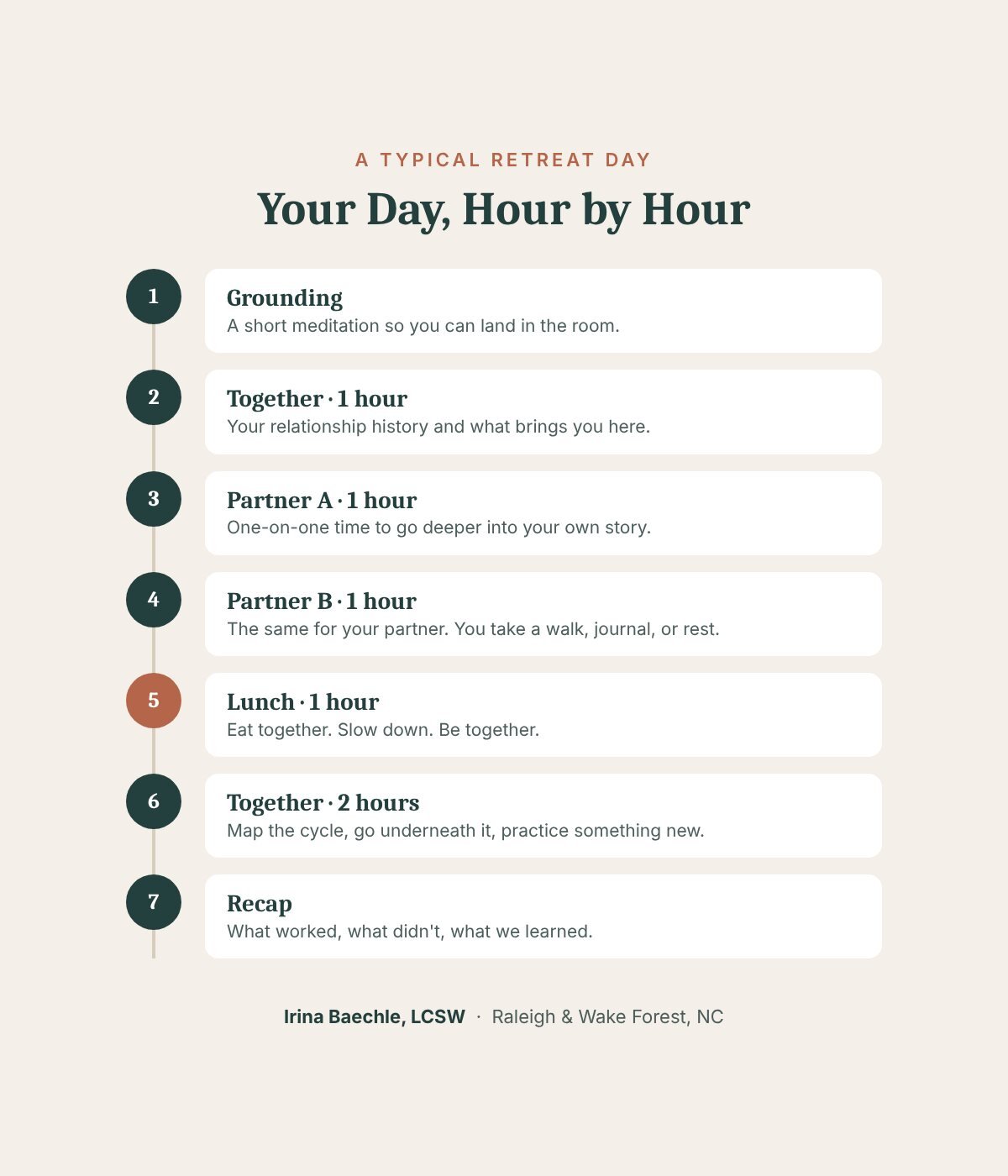
A retreat day is six hours, including a one-hour lunch, so we have five hours of focused work together. Your first two days, the 2-day start, both follow the same shape:
Together: 1 hour
Partner A, one-on-one: 1 hour
Partner B, one-on-one: 1 hour
Lunch: 1 hour
Together again, ending with a recap: 2 hours
The monthly retreat days after that look a little different. I'll get to those below. First, here's what each part of your first two days feels like.
Hour One: Together
We start together. We talk about your relationship history and what's bringing you in right now.
While you talk, I'm listening for your cycle: who tends to pursue and who tends to withdraw, what happens when one of you reaches and the other pulls away, and what might be living underneath all that anger or shutting down. It's usually already showing itself in the room by the end of this first hour.
Hours Two and Three: One-on-One Time With Each Partner
Next, I meet with each of you individually for an hour. This is where we go deeper into your own story: your family, your attachment history, how emotions were handled growing up, and the things that are hard to say with your partner sitting next to you.
One important note: I have a no-secrets policy. If something comes up in your individual time that affects the relationship, it will come back into the room, either from me or from you. That's how we keep things safe and honest for everyone.
What the other partner does
While your partner is with me, you get an hour to yourself. Couples take a walk, journal, grab a coffee and stroll around downtown Wake Forest, or simply sit with what came up that morning. One client took a quick nap in an empty office next door, and it worked really well for him. Some couples nap in the car.
What I discourage: checking your phone, answering work email, or anything else that pulls you back into the busyness. This hour is part of the work.
Lunch: A Real One
Then we break for a full hour. You eat together, and I'm happy to recommend spots nearby.
But honestly, lunch has very little to do with food. Most of the couples I work with are very busy professionals, and this is a built-in hour to actually slow down. Chew your food. Take a walk. Be together and enjoy each other's company, maybe for the first time in a long time without a screen or a schedule in the way.
Afternoon: Two Hours Together
After lunch, we come back together for the longest stretch of the day. This is where everything from the morning starts to come together.
We map your cycle together, slow it way down, and move underneath it, to the fear, the hurt, and the needs driving it. Then we practice something new in the room, with me right there. I'll have you turn to each other. I'll help one of you say the true thing in a way your partner can actually take in. And I'll make sure the other partner has room to really hear it, without jumping in to defend themselves.
If we get stuck, or if old trauma is blocking the way, I might bring in brainspotting right then and there, if that's what the moment calls for.
We close with a recap: what worked, what didn't, and what we learned. Sometimes we end with a meditation.
Comfort is built in
We take as many breaks as you need. Some people get sleepy after lunch, so the mats, pillows and bolsters come out and you can lie down and close your eyes. I keep fidgets on hand, too. I go into this more in couples therapy for neurodivergent partners.
How Day Two Is Different
New couples start with a 2-day retreat. Day two follows the same shape as day one, including individual time with each of you, but it feels very different.
By day two, most of the assessment is done. I have a very good understanding of where you are as a couple, and I have a map of your emotional cycle. So we go deeper right away, into reprocessing your experiences and creating new corrective emotional experiences together, those moments where you reach for each other and your partner actually shows up.
And the monthly retreat days after that
After your 2-day start, we meet for one full day each month, and those days are shaped a little differently. Individual sessions become optional. When we don't do them, the day looks like this: two hours together, an hour for lunch, and then three more hours together.
By then we know each other well. I know most of your history, we have rapport, and everyone feels safe. We do a quick check-in, and then we jump right into the nitty-gritty, whether that's EFT, brainspotting, or ketamine-assisted psychotherapy when it's appropriate.
Leaving the Retreat
Most couples walk out exhausted. And hopeful. Exhausted and hopeful.
They tell me they have more clarity. They understand themselves better, and they understand their partner better. And a lot of them say the thing they didn't expect to appreciate: that I interrupted them, and that I didn't let the other partner jump in while their partner was talking. Because they finally got to hear their partner's whole experience, they understand them on a much deeper level.
What to do that evening
Take it easy. Don't go back to work. Don't open your laptop "just to check one thing." Have a sweet, quiet rest of the evening together. You did a lot of work today, and your nervous system needs time to settle.
What happens between retreat days
The month between retreats isn't empty. You'll have homework, customized audio messages to listen to, and optional check-in sessions if something comes up. I explain why that in-between time matters so much in why progress doesn't stick when there's a week between sessions.
So, Will It Work? Is It Too Late?
Remember those two questions from the beginning? Here's what I've seen over and over.
Once couples slow down and their defenses start to soften, most of those fears go away. Not because I talked them out of it, but because they see what's underneath each other's defensive behaviors. The yelling, the shutting down, the criticizing, the walking away. When you see what's really driving it, you realize you're on the same team. You're not against each other. You're both up against the cycle.
That's usually the moment hope comes back into the room.
A retreat tends to be a great fit if you feel stuck in the same cycle no matter what you try, you've done weekly therapy and feel like you're running in place, or you simply want to start rebuilding your connection now, not in two years. It isn't the right fit if there's active abuse, an active affair, or active addiction. I lay out the full picture in my guide to why a couples retreat gets you further than months of weekly sessions.
About Irina Baechle, LCSW

Hi, I'm Irina Baechle, a licensed clinical social worker and marriage therapist in Raleigh and Wake Forest, NC. For more than 15 years, I've helped couples move out of painful, stuck places and back toward each other.
I'm trained in Emotionally Focused Therapy (EFT), the most research-backed approach I know for healing emotional distance and rebuilding trust. When it's appropriate, I also use brainspotting and ketamine-assisted psychotherapy to expedite results. I've offered couples retreats since 2017, and today it's the only way I work: a 2-day start in my cozy private office in downtown Wake Forest, then monthly 1-day retreats for 12 months or longer. You can read the full picture in my guide to why a couples retreat gets you further than months of weekly sessions.
I believe in the power of healthy relationships, and I want healthy, trustworthy marriages to be the norm, not the exception. I'm direct, I'm warm, and I'll tell you what I see without shame.
Topics I write about include marriage, infidelity, roommate marriages, sexless marriage, ketamine-assisted psychotherapy, healthy second marriages, and healing after toxic or unfaithful marriages.