You've decided to get help. That's a big deal, and honestly, it's the hardest part.
Now you're looking at two very different options. Weekly sessions, 50 minutes at a time, the way most people picture couples therapy. Or a couples retreat: full days of focused work, once a month. And you're wondering which one is right for the two of you.
Let me be upfront: I only offer retreats. But I'm not going to pretend weekly therapy is never the right choice, because sometimes it is. So here's my honest take on how to choose, whoever you end up working with for marriage counseling in Raleigh NC.
The Two Formats at a Glance
| Weekly sessions | Couples retreat (my format) | |
|---|---|---|
| Session length | 50 minutes | About 5 hours of sessions plus a 1-hour lunch |
| How often | Once a week | 2-day start, then 1 full day a month |
| How long | Varies, often many months or years | 12 months or longer |
| Between sessions | A week, usually without structure | Homework, daily check-ins, audio messages, optional 75-minute check-ins |
| Scheduling | Easy to fit an hour in, week to week | Planned months ahead; a full day off work, plus childcare |
| Cost | Varies widely by therapist | $3,500 per retreat day; no insurance |
| Pace | Small steps, lots of catching up | Deep work with room to finish what we start |
| Best for | Lighter support, unpredictable schedules, couples who aren't in a rush | Couples who feel stuck and want real change, sooner |
When Weekly Sessions Are a Good Fit
You're not bought in yet
A retreat is a big commitment. You're spending real money, setting aside a whole day, not working, and finding childcare. If you're not sure yet that you trust the process, or that you feel safe with the therapist and believe they're competent, it can make sense to start smaller.
Back when my practice had more room, I sometimes offered a couple of 75-minute sessions first to couples who liked my approach but were nervous about starting with a full retreat. Those couples weren't against the retreat. They just needed to feel confident that it was a good investment before jumping in. A few weekly sessions can do the same thing.
You can't plan your schedule months ahead
At the end of a 2-day start, my couples schedule their retreat days for the next six months or more. If one of you travels a lot, or you genuinely have no idea what your schedule will look like in four months, that's hard. For you, weekly sessions might work better. You can almost always find one hour for therapy. Canceling work for a whole day is a different story.
You're doing well and want to do even better
If your relationship is in a pretty good place, you're not in a rush, and you just want to strengthen what you have, weekly can work well.
When a Retreat Is the Better Fit
Here's the thing, though. The couple who's doing great and wants a tune-up is not who usually calls me.
Most couples wait. They come in after years of the same negative cycle. They feel really stuck and really disconnected. Often it's some kind of rock-bottom moment, the straw that broke the camel's back. I write more about why couples wait so long in "we wish we'd done this years ago" [LINK: #5].
And those couples need results. When I ask couples how quickly they want to see things change, most of them say "yesterday."
A retreat tends to be the better fit if:
You keep landing in the same fight no matter what you try
You've already done weekly therapy and feel like you're running in place (here's why 50 minutes a week isn't enough [LINK: #1])
You have breakthroughs, but they don't last (I explain why progress doesn't stick when there's a week between sessions [LINK: #3])
You're recovering from a rupture like an affair that has fully ended
One or both of you has ADHD and weekly sessions feel scattered (more on couples therapy for neurodivergent partners in Raleigh NC [LINK: #4])
You want to start feeling better now, not in two years
Who a Retreat Isn't For (Yet)
A retreat isn't the right first step if there is active, ongoing abuse, an active affair, or active addiction. In those situations, I refer to individual therapy first, so the person can work on their behaviors and stop the affair, the addiction, or the abuse. Safety has to come first, before any kind of couples therapy.
It also isn't the right fit if you've already checked out, and you're only staying together out of habit or for the kids.
Let's Talk About Cost
A retreat day with me is $3,500, so the 2-day start is $7,000. Insurance doesn't cover it. That's a real investment, and I don't want to downplay it.
Weekly rates in Raleigh are all over the place. Some therapists charge $50 an hour, and some charge $1,000. So instead of doing math that won't match your situation, here's how I'd think about it.
Compare what you'd spend on a format that gets you results with what you'd spend on months or years of sessions that don't. Then add the costs that never show up on an invoice: the hours, the hope, and the years of living disconnected.
And here's my honest opinion: even $10 is too much to pay for bad therapy.
Training matters more than the hourly rate
Most people don't know this, but a lot of therapists who graduate with a master's or even a doctorate in marriage and family therapy or counseling have had maybe one class on how to do couples work. And many of them don't actually work with couples. They work with kids or do family therapy.
Couples work is very different from individual therapy. So whoever you choose, find someone with real, specialized training.
You Can Use Both
Weekly therapy and a retreat aren't always either/or. Some of my couples see a weekly couples therapist and come to me for a deep dive: one retreat day, two, or several. We get to a really good place together, and then they go back to their weekly therapist.
When that happens, I coordinate with the other therapist on everything, so the work stays connected.
And if weekly is what fits your life right now, I'm happy to refer you to therapists I trust and whose clinical expertise I know.
Questions to Ask Any Couples Therapist
Whichever format you choose, ask these before you start:
What training do you have in couples work, and what method do you use? I'm trained in Emotionally Focused Therapy (EFT).
How much of your practice is couples?
How do you handle it when a session ends in the middle of something big?
How do you handle trauma if it comes up? Most of us have some.
What does progress look like after three months, and how will we know it's happening?
Still Not Sure? Listen to Your Gut
If you've read this far and you're still torn, here's the most important thing I want you to know.
Listen to your gut. You probably already know which one feels right.
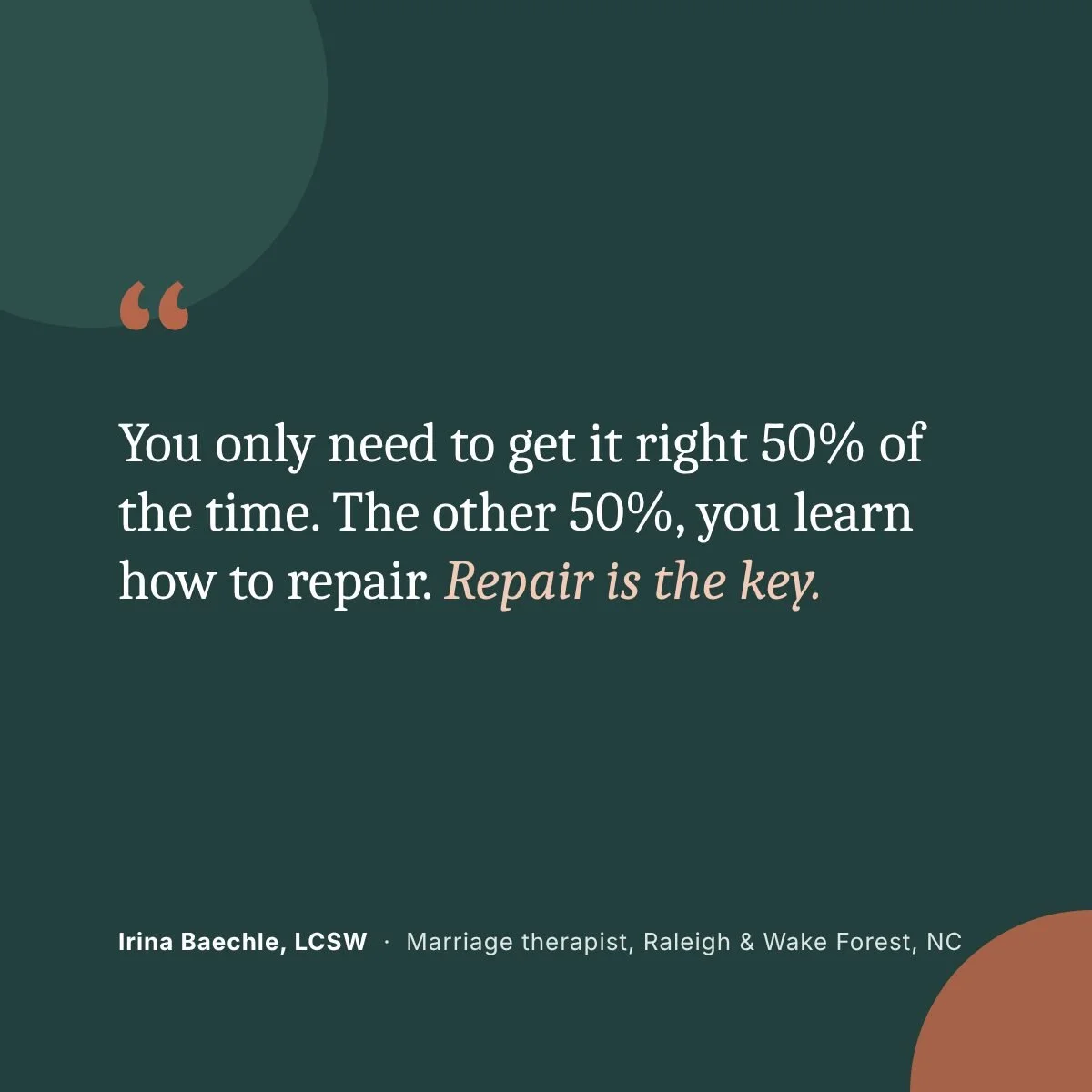
And while you're listening, let go of everything you've been taught about how marriage is supposed to be easy and natural. That's bullshit. Nobody gets it right all the time. You only need to get it right about 50 percent of the time. The other 50 percent, you learn how to repair.
You don't ever have to make it perfect. Repair is the key. And whichever format you choose, learning how to repair is what the work is really about.
If you want to see what a retreat actually looks like, I walk through it in what actually happens during a couples retreat in North Carolina [LINK: #2]. For the full picture of why I work this way, read my guide to why a couples retreat gets you further than months of weekly sessions [LINK: pillar]. And if you'd like to talk it through, a free consultation call is a great place to figure out which format fits you best.
About Irina Baechle, LCSW

Hi, I'm Irina Baechle, a licensed clinical social worker and marriage therapist in Raleigh and Wake Forest, NC. For more than 15 years, I've helped couples move out of painful, stuck places and back toward each other.
I'm trained in Emotionally Focused Therapy (EFT), the most research-backed approach I know for healing emotional distance and rebuilding trust. When it's appropriate, I also use brainspotting and ketamine-assisted psychotherapy to expedite results. I've offered couples retreats since 2017, and today it's the only way I work: a 2-day start in my cozy private office in downtown Wake Forest, then monthly 1-day retreats for 12 months or longer. You can read the full picture in my guide to why a couples retreat gets you further than months of weekly sessions [LINK: pillar].
I believe in the power of healthy relationships, and I want healthy, trustworthy marriages to be the norm, not the exception. I'm direct, I'm warm, and I'll tell you what I see without shame.
Topics I write about include marriage, infidelity, roommate marriages, sexless marriage, ketamine-assisted psychotherapy, healthy second marriages, and healing after toxic or unfaithful marriages.
Have questions about marriage counseling in Raleigh NC? Visit the FAQ or book a free 30-minute consultation.