Marriage Counseling Wake Forest NC: Difference Between Withholding, Omitting, and Lying

Marriage counseling Wake Forest NC helps you understand the subtle differences between outright lying, withholding, and omitting, why they matter, and how to protect emotional safety and intimacy in your marriage.
The Quiet Ways Trust Gets Broken, and How to Protect Emotional Safety
Let’s talk about a secret to lasting intimacy… and sometimes the sticky mess that it can get us into. Let’s talk about the differences between withholding, omitting, and lying. This is something that comes up week after week in my marriage counseling Wake Forest sessions.
Not infidelity. Not endless fights. But the less obvious ways trust gets shaken. Withholding, omitting, and lying create many problems in a relationship, even when you have no intention of hurting it.
One moment you’re in a happy, loving marriage, and the next, you’re sitting across from your partner, wondering how you ended up feeling so far apart. It’s when you need more than just communication tips to help you reconnect. What you need is to understand what’s been quietly eroding trust.
Because, at the heart of every relationship and every marriage is emotional safety. We build our relationships on the belief that:
”I can trust you.”
“I am safe with you.”
“You will not knowingly harm me.”
When we withhold, omit, or lie, that foundation gets shaken. And everything else starts to fall apart.
You might also find helpful: From Frustration to Connection: How Marriage Counseling Wake Forest NC Can Transform Communication
What Is Withholding? (And Why It’s So Tempting)
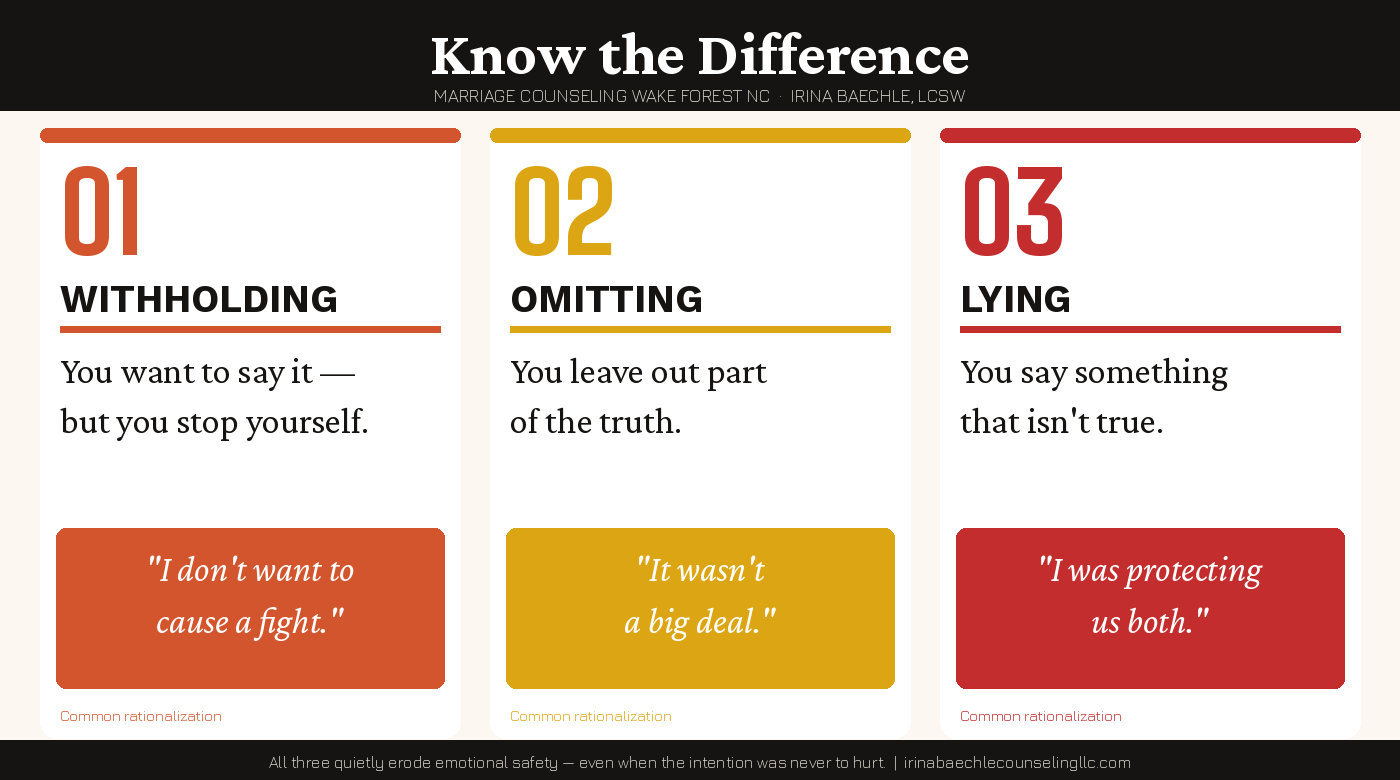
Withholding is when you really want to tell your partner something. You’re almost dying to say it. But you just can’t. You stop yourself. You hold back.
It’s like you really want to do something good, but for some reason—to protect yourself or to protect your partner—you’re just not going there. You tell yourself:
“I don’t want to hurt them.”
“This will only cause a fight.”
“I’m protecting the relationship.”
“I’m protecting myself.”
Withholding often sounds reasonable in our own heads. But here’s the hard truth I see over and over in marriage counseling Wake Forest: withholding erodes trust on a significant level.
Not because the information itself is always something that could threaten your relationship, but because your partner senses that something is being held back.
And that creates distance.
Imagine you’re feeling hurt by something your partner did days ago. You replay it in your head. Your nervous system goes on alert, and your body tightens. You want to bring it up. But every time you think about bringing it up, you decide not to. So you just move on, telling yourself, “It’s not worth it.”
Still, your partner can sense it. You’re colder. More distant. Intimacy fades. They don’t know why—they just know something feels off. So they start to pull back, too, and the silence between you grows a little more each day.
This is what withholding does to a relationship.
What Is Omitting? (The Dangerous Gray Area)
Then there is omitting. Omitting is different.
Omitting can be intentional or unintentional, and I see a lot of it happening in my couples work.
Here’s a typical example I see in my marriage counseling Wake Forest sessions: you’re telling your partner about your day. You mention work. You mention errands. You mention lunch. You just forget to mention one part—that you grabbed lunch with your ex, or something like that.
Why do you do it?
Because it doesn’t feel like a big deal, especially if it never comes to light. You think, “Nothing happened.” “It didn’t matter.”
You might think it’s not going to do anything to your relationship. And really, if that omission never comes to light, it may not affect the relationship at all.
But if it does come out, and your partner realizes that you omitted that information, it becomes a whole different game. And again, it can erode trust, create miscommunication and misconnection, and lead to all kinds of other negative consequences.
Why Omitting Can Be Just as Damaging as Lying
When your partner later discovers that you were omitting information, they don’t hear:
“I forgot to mention it,” or “It wasn’t a big deal.”
They hear:
“I chose what reality you were allowed to see.”
And suddenly, something that “wasn’t a big deal” turns into a huge relationship breaker.
Why?
Because omitting erodes trust and creates disconnection. Your partner starts questioning everything – your loyalty, your commitment, your love. And once trust is shaken, the relationship no longer feels emotionally safe. Even when the original intention wasn’t harmful. Your partner begins to wonder, “How do I know this won’t happen again?” And that doubt spills into everything else.
Now, when you say you’re meeting a friend for dinner, it can trigger suspicion, even if nothing inappropriate is happening. Over time, this fuels miscommunication, ongoing conflict, and a constant sense of tension in the relationship.
This is why, in marriage counseling Wake Forest, we don’t just look at what happened. We look at how it impacted emotional safety.
And Then There’s Lying (The Most Obvious—but Not the Only—Problem)
And then there is lying. That one is pretty straightforward—it’s when you directly say something untrue. For example, you tell your spouse that you went golfing with your friends. But you leave out—or lie about—the fact that a couple of your friends brought their spouses or significant others, and you didn’t invite your partner—maybe because you were going through a rough time or something like that—and you just lied about it.
Lying has a lot of gray area. It can feel more complicated than we expect. And honestly, all three of these—lying, omitting, and withholding—are where people get lost and confused. But at the heart of the matter, what’s really happening is that you’re playing with fire.
And that fire is trust.
You might also find helpful: Unlocking Peaceful Conversations: How Marriage Counseling Wake Forest NC Can Help You Break the Fight
Trust Is the Fire You Don’t Want to Play With
Marriage is built on emotional safety and on trust. When you shake trust, you shake emotional safety. And when that happens, you open a whole can of worms—other things that are going to start happening in the relationship:
· Hypervigilance
· Suspicion
· Anxiety
· Control behaviors
· Emotional withdrawal
· Intimacy loss
· Resentment
This is often when couples end up in marriage counseling Wake Forest for months—or even years.
Marriage Counseling Wake Forest: “But I Was Just Trying to Protect the Relationship…”
I hear so many couples say:
“I was trying to protect them.”
“I was trying to protect us.”
“I didn’t want to cause pain.”
And yet…
Whether trust was broken intentionally or unintentionally doesn’t matter to the nervous system. When one partner is withholding the truth, omitting information, or lying—and those things later come to light—the other partner’s nervous system goes on high alert because it senses danger.
When our nervous system detects a threat, it sends our body into fight-or-flight mode. We become tense, hyper-aware, always on the lookout. And with broken trust, the problem is that this state of heightened alertness doesn’t turn off. It lingers.
This is when I see couples come to work with me for six, twelve, twenty-four, even forty-eight months, repairing trust that was broken—whether intentionally or unintentionally. People often say they are withholding, omitting, or lying to protect the relationship or the partner. It doesn’t really matter. When trust is broken, it takes months or years to rebuild. Sometimes much longer if old wounds are present
The body needs time to relearn that the relationship is safe again.
You might also find helpful: Marriage Counseling Raleigh NC: What Does a Naive Scientist Have to Do with Effective Communication?
When Past Trauma Makes Withholding, Omitting, and Lying Even More Dangerous
This is why I always say in marriage counseling Wake Forest: Be very, very careful with your language.
Especially if your partner already has a history of broken trust from:
· parents
· caregivers
· previous relationships
· significant others
For them, this can be a very sensitive, raw spot, and if it’s broken again, it can take even longer to repair.
A few years ago, I worked with a couple who came to me after a female partner omitted details about a phone call with her ex. The husband found out later. Nothing inappropriate had happened—she wasn’t having an affair with her ex-partner or anything like that. It was just a conversation about a school reunion. But she had omitted that information because she didn’t think it was a big deal, and she didn’t want her spouse to think something was going on. So she told herself it was better for everyone if she simply didn’t mention it.
The husband’s reaction was intense.
Why?
Because he grew up in a home where the truth was constantly hidden from him. Where he witnessed ongoing fights between his parents because his father was having affairs. In a house where secrets were the norm, and trust was broken again and again. To his nervous system, the omission didn’t feel small. It felt familiar. And it felt threatening.
With his partner, he had finally felt safe and seen, for the first in so long. That’s why her omission felt like such a big deal to him.
Repairing that with marriage counseling Wake Forest took time, consistency, and a lot of work on rebuilding emotional safety.
You might also find helpful: Triggered? It Might Not Be About You: Understand Emotional Reactions in Relationships with Marriage Counseling Wake Forest
Marriage Counselor Shares a Tip: What Actually Helps is Clarity, Not Perfection
Here’s the part I want couples to really hear:
This isn’t about being perfect. There is no such thing as a perfect marriage. There is no such thing as a perfect human being. The mere fact that we are human means we are bound to imperfection.
It’s about being clear. Honest. True to yourself.
However, being clear doesn’t mean dumping every thought or detail. It means asking yourself:
Am I holding back something important?
Would my partner feel differently if they were aware of this?
Am I choosing comfort now over safety later?
Practical Takeaways from Marriage Counseling Wake Forest
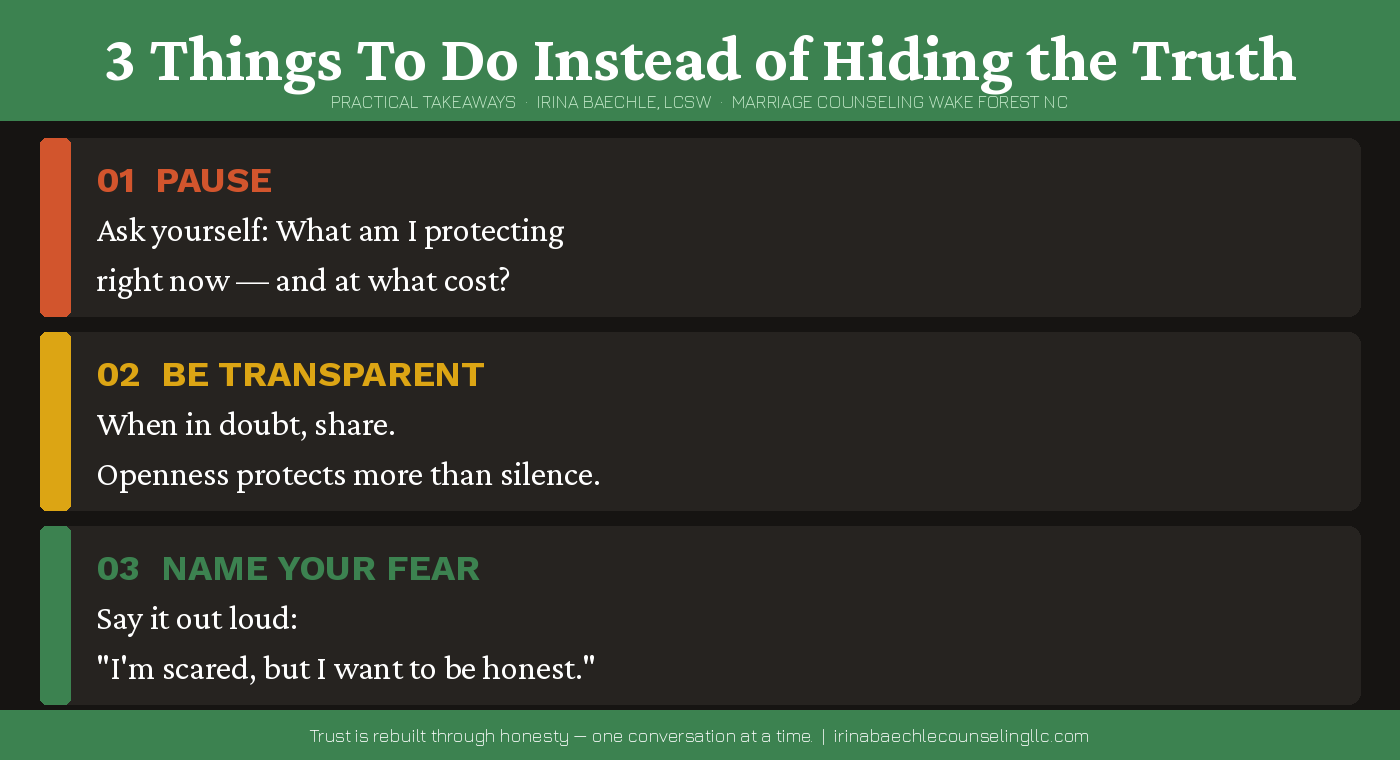
1. If You Feel the Urge to Withhold—Pause
Ask yourself, “Why is it important for me to keep this from my partner? What am I protecting? And at what cost?”
2. When in Doubt, Choose Transparency
Whenever you find yourself weighing whether to share something with your partner, remind yourself that openness and honesty are the foundation of a healthy, lasting marriage. This becomes especially important if your partner has a history of insecure attachment, trauma, or broken trust. Ask yourself, “What’s the worst that could happen?” and “How would I react if the roles were reversed?”
3. Name Your Fear
Instead of hiding information, try using the “I language.” Say to your spouse, “I’m scared this will hurt you, but I want to be honest,” or “I am afraid that this might upset you or make you angry, but I don’t want to keep it from you.”
If you’re unsure how to share something, try saying, “There’s something I’ve been holding back because I didn’t want to hurt you. But I care about our relationship too much to let it sit unspoken.”
It’s the honesty that matters. And when you open up this way, it’s much more likely that your partner won’t react in the way you feared.
Marriage counseling Wake Forest isn’t about policing your thoughts or forcing radical honesty. It’s about protecting emotional safety. Because when you feel safe, intimacy grows. Connection deepens. Conflict becomes manageable, and trust repairs more quickly.
You might also find helpful: Reconnect and Rekindle: How Enactments Benefit Couples in Marriage Counseling Raleigh NC
FAQ: Withholding, Omitting & Trust in Marriage Counseling Wake Forest
Is withholding the same as lying?
No. Withholding is keeping back information you intend to share, but, for some reason, don’t feel comfortable doing so. Lying is directly saying something untrue. But both can damage trust.
Is omitting always harmful?
It doesn’t always have to be. But if omitted information comes out later and affects how safe your partner feels, it can erode trust and create many problems in your relationship.
What if I were trying to protect my partner?
Intent matters, of course. But impact matters more. Ask yourself, “Am I really protecting my partner here? Or am I protecting myself from discomfort in the moment?” Even if you are trying to protect your partner because you don’t want them to worry or get hurt, your good intentions can break trust if you compromise their emotional safety.
How long does it take to rebuild trust?
It may take months or years to repair broken trust, especially if past trauma exists. Early repair prevents resentment and helps shorten the process.
Can marriage counseling help with trust issues like this?
Yes. Marriage counseling Wake Forest focuses on rebuilding emotional safety, understanding patterns, and creating repair, not blame.
If you’re struggling with trust, communication, or emotional safety in your relationship, you don’t have to go through it alone. Trust can be repaired, but it starts with understanding what quietly breaks it in the first place.
Contact me today to schedule your free phone consultation. I would be thrilled to support you in rebuilding trust, restoring emotional safety, and finding your way back to a relationship that feels connected, honest, and secure.
Quality Marriage Counseling and Ketamine Assisted Psychotherapy in Wake Forest NC
At Marriage Counseling Wake Forest NC, I offer the best marriage counseling I can, using the most empirically validated modality called Emotionally Focused Couples Therapy (EFCT) and Ketamine Assisted Psychotherapy, when appropriate, to really expedite the results.
This is not your typical weekly kind of therapy. I am here to help couples and individuals in relationships do what has been proven to help them heal their relationships. Through marriage counseling Wake Forest NC, marriage retreat in North Carolina, individual counseling, and Ketamine Assisted Psychotherapy, there is something for every couple who wants to heal their relationship.

Hi, I'm Irina Baechle, LCSW, in Raleigh, NC. I believe in the power of healthy relationships and write about them. Whether you and a partner are co-creating a healthy marriage or you are single, navigating healthy relationships, my content is for you. Let's make healthy, trustworthy marriages the norm instead of the exception!
Topics I write about include marriage, infidelity, roommate marriages, sexless marriage, ketamine assisted psychotherapy, healthy second marriages, and healing after toxic or unfaithful marriages.
Have questions about marriage counseling? Visit the FAQ to find out more.