
Ketamine Therapy North Carolina
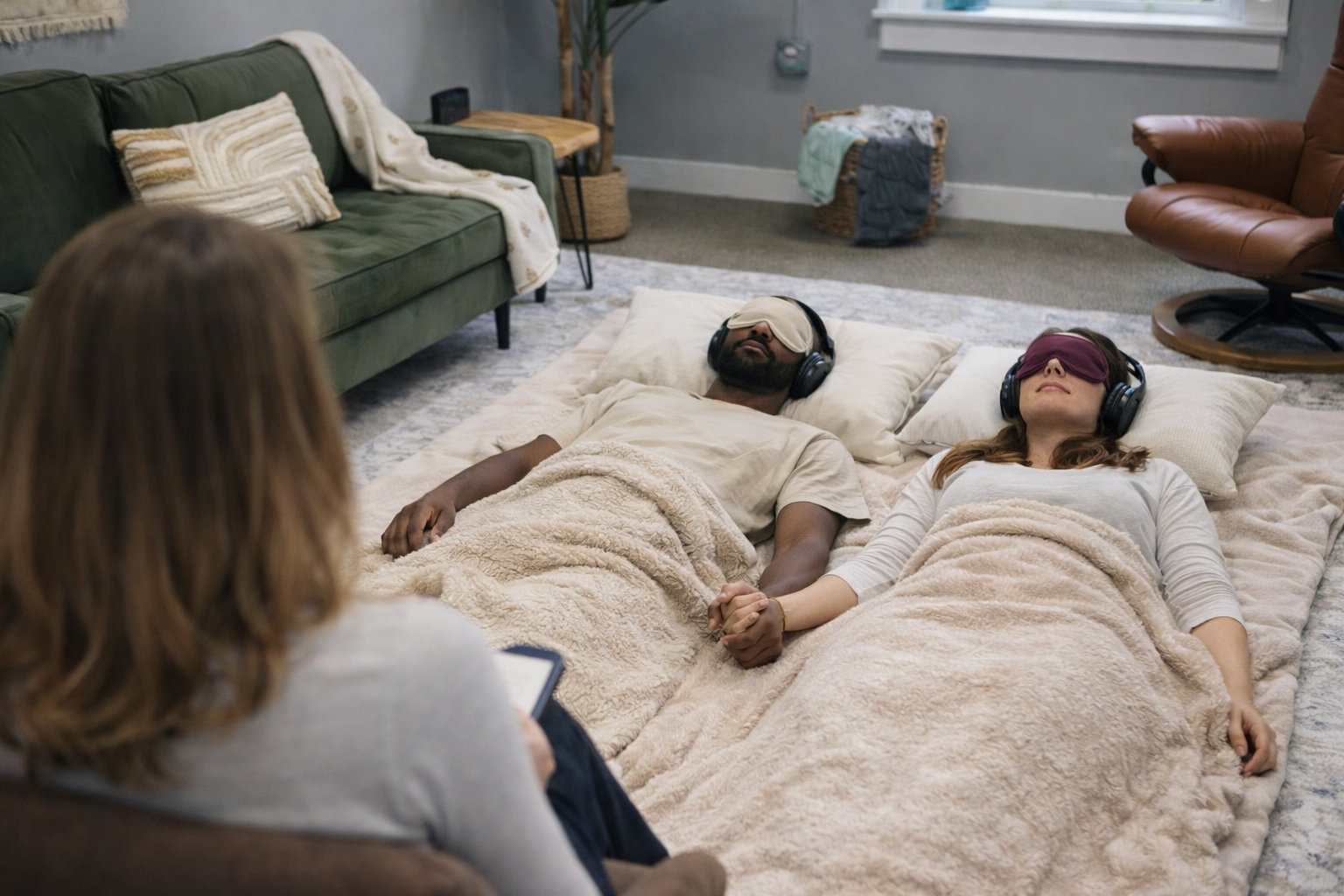
Curious about ketamine-assisted therapy for couples? Learn how KAP, EFT, and intensive couples work may help partners soften defenses, break old patterns, and reconnect.
You Understand the Pattern. So Why Are You Still Stuck?
You have done therapy for years. Maybe even you both did it individually and as a couple. You spent hours and hours talking, unpacking, revisiting, and figuring things out.
So, you do understand your patterns. You can recognize what drives them. You understand the "dance." You can predict the steps. You know who pursues and who shuts down. You know things logically. You may even know exactly which childhood wound gets activated whenever your partner doesn't answer your text or goes quiet during an argument. Why one of you desperately wants to feel important. And why the other feels attacked, inadequate, overwhelmed. Why one of you always demands. And why the other shuts down.
So why do your conversations still feel more like an endless to-do list than a real dialogue between two people who deeply care about each other, and who once felt deeply connected and passionate?
Why do you still get activated the moment he says something that doesn't land quite right?
Oh, yes... you still love each other deeply. Maybe you're not even considering divorce. But for years now, you've been feeling more like business partners or roommates than romantic partners. It's frustrating. It's exhausting. And it's a heartbreaking pattern I've seen in so many couples.
There is a way to break years of disconnection, though.
You might also find helpful: How Does a Marriage Retreat in North Carolina Work?
What is Ketamine-Assisted Therapy?
Ketamine-assisted psychotherapy (KAP) for couples is not about taking a medicine to "fix" your marriage quickly. To numb your problems. To make your pain just "go away." KAP combines ketamine with deep psychotherapy to soften rigid defenses, increase psychological flexibility, and create space to experience yourself and your partner differently. In my work as a marriage therapist in Wake Forest, I combine KAP with Emotionally Focused Therapy and, when appropriate, brainspotting intensives for couples.
What Is Ketamine Therapy for Couples in North Carolina?
In a marriage retreat in North Carolina, ketamine is not the therapy. It is the catalyst.
So why do I combine ketamine with psychotherapy in my marriage counseling work in Wake Forest?
Because EFT for couples gives us the safety and relational context we need to make those new experiences actually mean something.
It creates space for you and your partner to stay present with each other while exploring the feelings, needs, old wounds, and relationship patterns underneath the conflict. It also helps you make sense of what comes up, deepen the insight, and begin integrating the experience in a way that can actually shift the relationship.
And where does ketamine fit into all of this?
Ketamine helps quiet some of the mental noise and may allow you to step outside your usual ways of thinking, feeling, and reacting. This temporary altered state can create space for new perspectives, deeper emotional insights, and a greater sense of connection with yourself and, sometimes, with something larger than yourself. Ketamine, used alongside EFT, can open your heart and help you finally move out of resentment, exhaustion, and disconnection.
When used by a skilled therapist, ketamine can help you:
· Zoom out from rigid narratives
· Soften resistance
· Calm your nervous system
· Tune into feelings you usually defend against
· Quiet some of the mental noise
· Access shame, fear, longing, and grief that is difficult to reach in an ordinary state
You may know intellectually that your partner's anger actually comes from a fear of losing you. But in an argument, you still hear criticism and judgment, and your body just shuts down. And for your partner, while they know rationally that your silence is protective, in that moment their nervous system reads it as abandonment.
You might also find helpful: Marriage Counseling Wake Forest NC: How Ketamine Therapy Helps You Reconnect When Traditional Therapy Isn’t Enough
Ketamine-assisted therapy may create enough flexibility to experience that interaction (and every other similar interaction) differently.
Many of my clients say this form of therapy is new to them. And it's okay to have doubts when something is new and unfamiliar. That's completely understandable. But with ketamine therapy, there are years and years of research. It is not some brand-new idea that came out of nowhere. Ketamine has been studied for decades, and we know a lot more now about how it can be used in mental health treatment.
Why Ketamine Therapy?
Ketamine is a dissociative anesthetic that's been used in human and veterinary medicine for pain reduction and sedation since the 1970s. But over time, researchers discovered that sub-anesthetic doses of ketamine could also be helpful for different mental health conditions. Today, lower doses of ketamine are used off-label to support people struggling with depression, PTSD, anxiety, and other mental health concerns, particularly when traditional approaches haven't helped enough.
And one of the things that makes ketamine different from traditional antidepressants is how quickly it can work. Antidepressants may take weeks or even months before you notice a difference. But with ketamine, some people experience relief within hours.
When guided with care, ketamine therapy for couples is safe. Transformative. And it can foster healing in deeply meaningful ways.
How Ketamine-Assisted Therapy Actually Works
So, how does ketamine actually work?
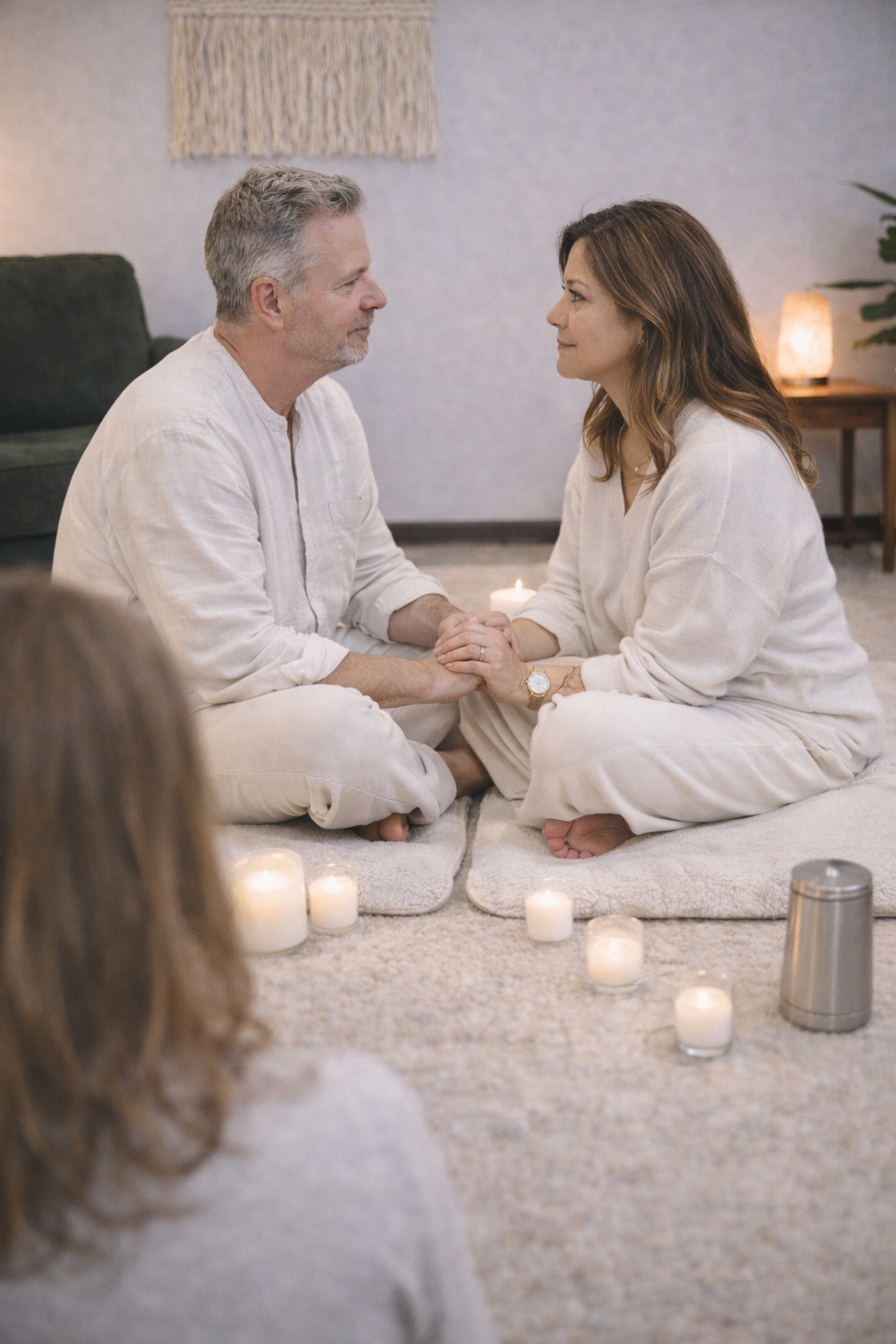
Traditional antidepressants typically work on chemicals like serotonin or norepinephrine ("feel-good hormones"), and it can take some time before you start to notice a difference. Ketamine works differently. It "awakens" the brain's glutamate system, including its NMDA receptors. This neurotransmitter helps the brain become more flexible and form new neural connections.
And that flexibility is important. It can help loosen some of the patterns your brain has been stuck in and create space for something new. Some people notice a shift after their first ketamine session, while for others, the benefits build over several treatments.
Of course, that doesn't mean a few hours or a few sessions suddenly erase everything that has been hurting between you. But when a ketamine retreat is combined with EFT, it can help soften some of the defenses, settle the nervous system, and give you a new felt experience of being connected. And that experience becomes something you can return to, strengthen, and keep building on over time.
Still, ketamine therapy in North Carolina might not be for everyone, and medical screening is required.
Before we begin ketamine therapy for couples, the first step is meeting with a qualified medical provider. Once you are medically cleared, you will receive the medication and bring it with you to your marriage counseling intensive in Wake Forest (keep reading to learn more).
Ketamine Therapy North Carolina: Why Talking About the Same Marriage Problems May Not Be Enough
You worked so hard. On yourself. On your marriage. You know that when you pursue, she withdraws. That when you become critical, he shuts down. You may even be aware that your childhood taught you to be cautious in relationships. That your attachment style made you sensitive to rejection.
And yet, when it happens again, you still feel stuck, almost exactly where you were at the beginning. Your body goes into stress-survival mode. Your muscles tense. Your breathing becomes faster. Your heart rate increases. You cry, yell, or lash out. Or you freeze, go numb, and simply shut down.
Let me tell you something I remind my clients of all the time: knowing your patterns and changing your patterns are not the same thing. You can analyze the struggles in your relationship and still react the same way when emotions run high.
You might also find helpful: When One Hour A Week Doesn’t Heal Real Hurt: How Intensive Marriage Counseling in Wake Forest Can Help You Reconnect
Your Nervous System Reacts Faster than Your Thinking Brain
And there's nothing wrong with that. It's simply your nervous system doing its job. Protecting you in the ways it learned long ago.
So, when your partner's tone, facial expression… or even their silence and distance remind you of an earlier emotional injury, your body can go into protection mode before your conscious mind has time to catch up.
Old wounds become present-day relationship triggers
And that earlier hurt can come from many places: your childhood attachment experiences, trauma, betrayal, infidelity, pain from a previous relationship, chronic feelings of inadequacy, or years of accumulated marital hurt and resentment.
So, when he forgets to text you back all morning, you're not really fighting about the unanswered text anymore. Your nervous system is screaming, "I don't matter to you!" And then you carry that hurt around with you for the rest of the day. Then you get home that evening, and a random conversation about whose turn it is to do the dishes suddenly turns into an epic fight. And your partner's nervous system is screaming right back, "No matter what I do, I'll never be good enough."
That is where your relationship dance happens. Where the negative cycle lives.
Ketamine therapy for couples helps you not only understand the pattern, but also discover how you can respond differently when you're right in the middle of an emotional moment.
Why Ketamine May Help Create a Different Kind of Opening
It May Quiet Repetitive Mental Loops
A client recently told me, "Those thoughts that play on repeat sometimes just drive me crazy."
"He doesn't care."
"She'll never understand me."
"I'm always the problem."
"Nothing is ever going to change."
And I'm sure many of you can relate.
Ketamine may temporarily quiet some of that mental chatter and loosen the grip of these familiar stories. Instead of automatically following the same thought again and again, you may have a little more space to pause. You step outside of it. And... you begin to see things differently.
Sometimes, that tiny amount of space is enough to notice something you couldn't see before.
Defenses May Soften
Over all these years, you may have built walls that helped you feel safe.
Maybe you deal with arguments by pulling away. Maybe you learned to shut down when emotions become too intense. When conversations threaten to hurt you. Maybe you stopped asking for what you need because you know you'll be disappointed. And that hurts so much. Maybe you put your partner's needs (and everyone else's) ahead of your own because you don't want to rock the boat. To be reliable. You slowly lost touch with what you need. Or the moment another difficult issue comes up in your relationship, you become distant. Cold. Detached.
You keep yourself occupied. You stay busy with the kids. You have a thriving career. You spend time with friends (maybe you even tried doing ketamine together recreationally). You contribute in your community. From the outside, you may look like a successful person who has it all figured out.
And those behaviors didn't come out of nowhere. Your nervous system has probably used them for years to keep you safe. But these strategies keep you safe.
Safe, but lonely. They made it harder to feel close to your partner.
With ketamine therapy for couples, some of these defenses may begin to soften. Not disappear after one intensive. Not magically lift the weight that's been building up for years. But soften enough that you may be able to stay with an emotion instead of immediately protecting yourself from it. And when they do, you may find yourself asking questions you haven't allowed yourself to ask in a very long time:
What do I need? What am I actually afraid of? What am I protecting myself from? What do I wish I could ask my partner for?
And when we combine that with EFT, we can use that opening to explore what is underneath the wall in the first place. Hurt. Fear. Loneliness. Longing. The parts of you that still want connection but haven't felt safe enough to reach for it.
You might also find helpful: Why EFT Focused Marriage Retreat in North Carolina?
Ketamine is Associated with a Period of Increased Neuroplasticity
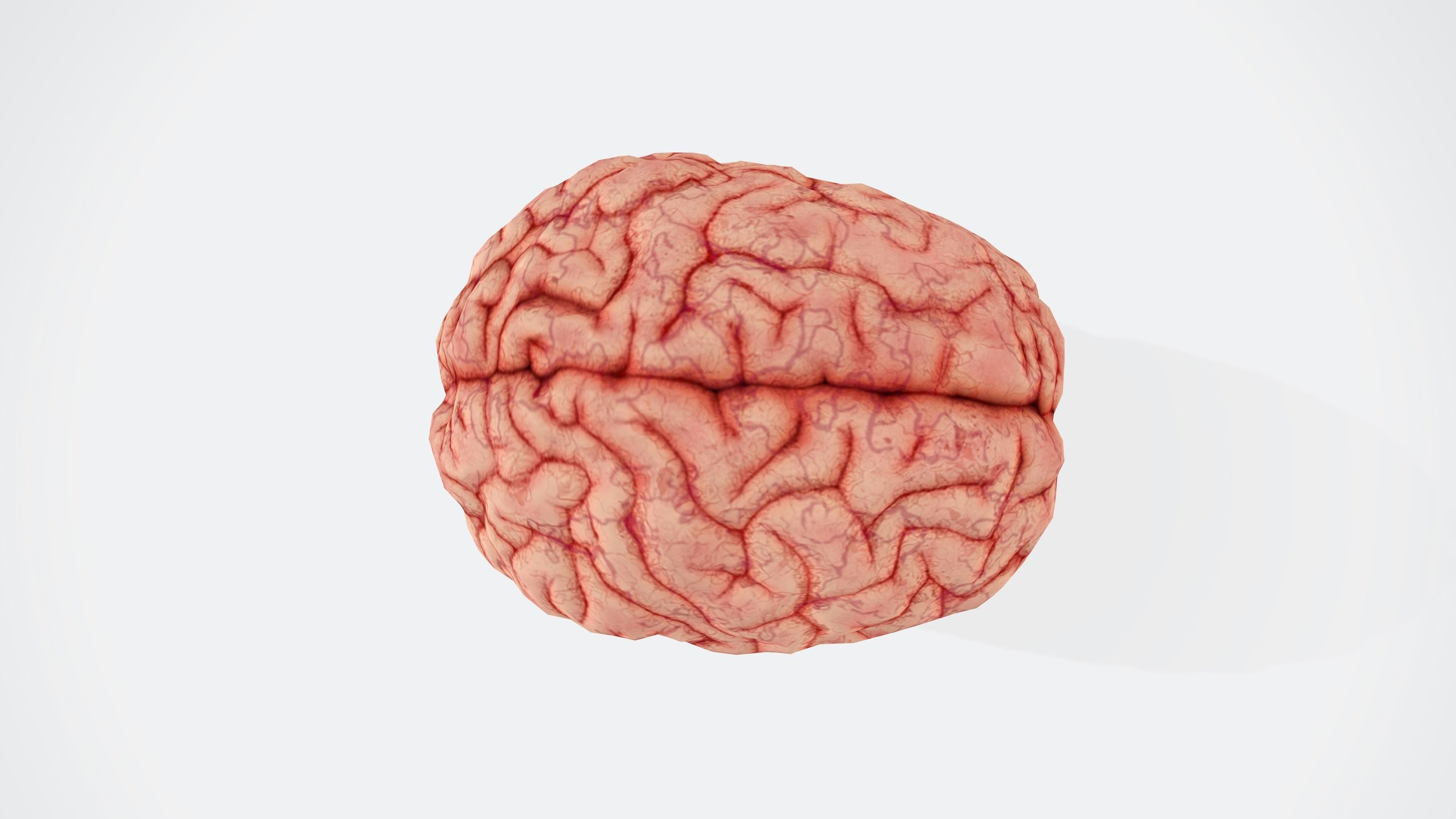
Ketamine creates a roughly 36–72-hour window of enhanced neuroplasticity, allowing new insights to emerge and new habits to take root. For some clients, this experience almost feels like hitting the brain's reset button.
The Goal? Greater Flexibility.
Some people experience profound insights. Others don't. Whatever ketamine therapy for couples feels like for you, you didn't do it wrong.
The therapeutic value isn't measured by how dramatic or profound the experience feels.
What Ketamine-Assisted Therapy for Couples Actually Looks Like
So, what does ketamine therapy with me feel like? Let me show you what this journey can look like when we work together.
Before the Intensive: Medical Screening and Preparation
Before the ketamine retreat, a small amount of ketamine (we call it a psycholytic dose) is prescribed by your physician. Before they prescribe you ketamine, the doctor completes a thorough medical evaluation to make sure your health is stable and that ketamine is safe to use. They will review your medical history, possible contraindications, current medications, and any mental health risks to make sure ketamine is appropriate and safe for you.
Once approved, the clinician gives you the medication, which you then bring with you to ketamine therapy North Carolina.
Day One: Understanding the Cycle
During your first day (6-hour session), we slow everything down. Emotions. Patterns. Defenses. The cycle.
Together, we work on understanding the relationship dance that keeps both of you feeling lonely in your marriage.
For you, that might mean getting "big" and loud in an attempt to have your needs heard, only to end up feeling disappointed and hurt. For your spouse, it may mean withdrawing and disconnecting because they feel that no matter what they do, it's never enough. They're never enough.
And the dance repeats. Over and over again. One of you feels unimportant. The other feels like they can never get it right.
Together, we go underneath all of that.
I help you reach the deeper emotions, longings, fears, and truths beneath the reactions: the desperate need to feel important to your partner, the shame of feeling like you're not enough, the fear of rejection or abandonment.
By the end of Day One, things often begin to make more sense. You start to see what is happening beneath the behaviors and what happens when your nervous system becomes activated and reactive. You may begin to realize, "This is what I actually need. This is what I'm scared of. This is how we keep pushing each other further and further away."
We work in blocks of approximately two hours, with breaks in between, including time for lunch. Then we come back and continue the work. During the final hour or so, we slow things down and recap what we've learned during Day One. We also talk through what to expect and how to prepare for the ketamine session the following day.
Day Two: Medicine, Experience, and Integration
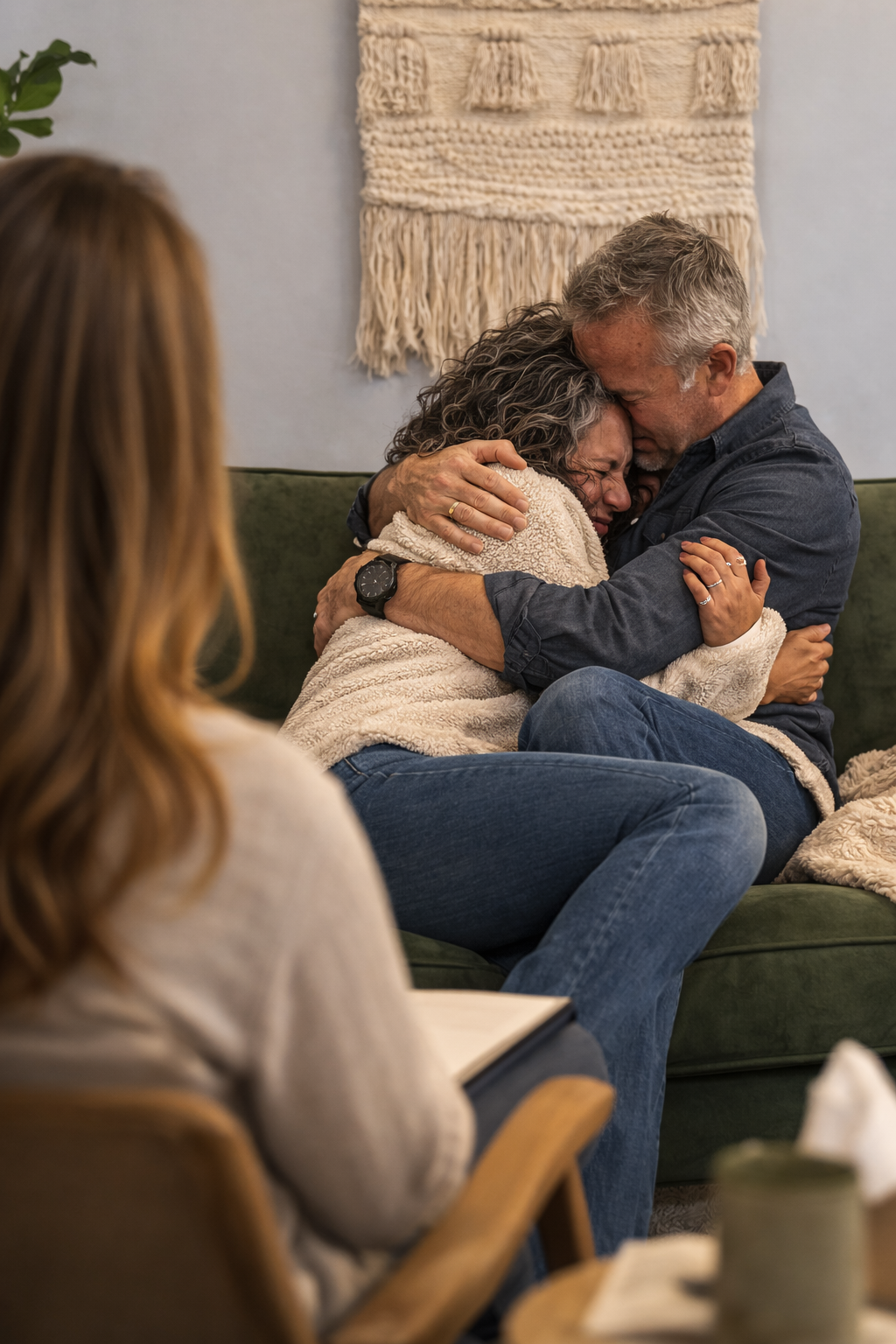
What exactly happens during a ketamine therapy session?
During the ketamine administration session, you will take sublingual ketamine, usually a lozenge or tablet, and it will slowly dissolve in your mouth. I'll ask you to hold the saliva in your mouth and swish it around for about ten minutes so the medication can be absorbed. You will settle into a cozy "nest" with pillows and blankets. The music I've chosen carefully for the session will play while you wear an eye mask and headphones. You'll begin journeying inward while I support from the outside, observe, and take notes.
Keep in mind that every session and every experience is unique.
But many of my clients describe something similar. As the ketamine begins to work, things can start to feel a little softer. Your body relaxes. You feel less guarded. Less braced for the next thing to go wrong.
And sometimes, the defenses you've carried for years begin to loosen their grip.
You may find yourself more open. More vulnerable. And, surprisingly, okay with that.
You listen differently. You look at your partner differently. You're less busy protecting yourself and more able to actually take them in. And for a little while, it can feel safer to be honest. To say what you really feel. To let your partner see the parts of you that usually stay hidden. You step outside of your usual way of seeing yourself, your partner, and your marriage. You begin to look at your experience from a different perspective.
Every experience is different, of course. For some people, a new perspective means seeing the bigger picture. For others, it means turning inward and noticing feelings, needs, or fears that you couldn't access before.
And that shift in perspective can create movement where you've felt stuck for a long time.
Ketamine Is Not the Transformation. Integration Is.
Integration with a therapist is where the real transformation happens.
Life goes on after or between your ketamine retreat sessions in Wake Forest. Kids need you. Work piles up. Commute is exhausting. Old arguments arise. This is exactly why many of my clients did not see much benefit from doing ketamine with friends or sitting for each other.
In such a fast-moving world, it may seem difficult, almost impossible, to hold onto the stillness, insight, and calmness you've just found. But this is where the most important part of the work begins: integration.
After your marriage counseling sessions Raleigh NC, you and your partner begin introducing all those things you've discovered in ketamine therapy for couples into your daily life. Insights. Emotions. Memories. Body sensations. And that precious sense that something inside you shifted. Integration is the part where we slow down and make sense of all of that. It begins when you ask yourself one simple question: "What am I going to do differently with what I learned?"
What Integration Looks Like with Marriage Retreat North Carolina
You'll probably start some small new traditions, like going for a run together in the morning or having lunch together. You might journal. Do yoga. Move your body. Practice mindfulness. Become more curious. You'll likely start feeling more grounded in your body and with each other. You'll begin relating to one another with more calmness, openness, and vulnerability. You will start to notice the old pattern and choose a different response.
The point is not to overanalyze the experience. It is to stay curious about what came up and what it may be asking you to pay attention to.
Because this is where insight begins to become change.
Of course, some days will still feel heavy. Old patterns may show up again, and you may wonder whether anything is really changing.
Then there will be other days when things feel lighter. More hopeful. More open. More creative.
That back-and-forth is part of integration. You're taking in the experience, making sense of it, and slowly learning how to do something different with what you discovered.
And each time you practice that new way of responding, you're strengthening a different way of being together.
Ketamine Therapy North Carolina: What Else You Should Know?
In my marriage counseling practice in Wake Forest, I offer ketamine in two forms: sublingual/oral and intramuscular (IM). When ketamine is taken under the tongue, your body absorbs about 20 to 30 percent of it. With an intramuscular injection, almost the entire dose, around 95 percent, reaches your system. I don't offer IV ketamine in my practice.
For new clients, I usually ask for a commitment to at least three sublingual KAP sessions, with the option to continue with the full course of treatment if that feels appropriate for you (7-8 sessions).
Why at least three sessions? Because research and clinical practice show that benefits of ketamine therapy can build over time. For many couples, the first experience opens the door. Softens emotional defenses just enough to increase awareness of your patterns. The next one usually helps you to go a little deeper. And over several sessions, we have more opportunities to work with what comes up and integrate it into your everyday life and relationships.
That said, you are always in control of your treatment and can stop at any time.
Who May Be a Good Candidate for Ketamine Therapy for Couples?
You've tried different kinds of therapy. Maybe you've been working on your marriage for years. And still, somehow, you end up back in the same negative cycle.
You shut down. You pursue and feel rejected. You feel unimportant. You feel like no matter what you do, you're never enough.
Maybe you have a history of trauma that makes closeness feel unsafe, so you pull away when things get vulnerable. Maybe your attachment patterns from childhood make it difficult to access those softer emotions. To open up. To trust. Or maybe you understand your relationship patterns perfectly well intellectually, but you still can't seem to create a different felt experience with your partner.
You might also find helpful: Ketamine-Assisted Therapy for Couples: When Talking About the Problem Isn't Enough
Ketamine Couples Retreat vs. Weekly Couples Therapy
Don't get me wrong. For some couples, regular weekly sessions work just fine. But some couples don't have the luxury of spending years slowly working through the same patterns. Sometimes the relationship is hurting too much. The disconnection has gone too far. There's too much resentment, loneliness, or uncertainty to keep saying, "We'll work on it next week."
Some wounds need more time and space right now.
And that's where the concentrated, intensive work of marriage retreats in North Carolina can make such a meaningful difference. The intensive model is for couples who need sustained time and deeper access because it creates the conditions where something can actually shift. Two days in a row, six hours each, carved out just for the two of you. No kids. No work. No everyday chores. No emails. No distractions.
Instead of opening something painful and then stopping because the hour is over, we have the space to stay with it, go deeper, and actually begin shifting what keeps the two of you stuck.
So, think of it this way:
Weekly therapy is a slow renovation. A Ketamine retreat is a structural reset.
You might also find helpful: Myths About Marriage Counseling Intensives
Who Should Not Use Ketamine?
Ketamine may not be the right fit for everyone, which is why medical screening is required. Ketamine may not be safe for you if you have certain medical concerns or mental health conditions. It will not make you automatically addicted.
And we also need to look carefully at any medications, supplements, or substances you're taking, because some of them can interact with ketamine.
What Ketamine-Assisted Therapy Cannot Promise
Please don't go into this expecting every ketamine experience to feel profound or dramatic. One session may bring a powerful insight. Another may feel quiet, subtle, or even like "not much happened." That does not mean you did anything wrong or that the session had no value.
Each experience is different. What matters is what we become curious about afterward. In our integration work, we explore whatever comes up, whether that is an emotion, a memory, a bodily sensation, a new perspective, or simply a sense that something has shifted.
Ketamine may open the door. You still have to walk back into your marriage and live differently.
The Bigger Question Isn't "Will Ketamine Fix My Marriage?"
Ketamine is not a miracle medicine. It won't change your relationship or your life overnight.
So instead of asking, "Will ketamine fix my relationship?" ask yourselves: "Will it create enough safety and flexibility to experience each other differently?"
There is no medicine that can manufacture love, repair trust for you, or make the difficult conversations disappear. But for couples who have spent years understanding their pain without being able to move through it, KAP may create an opening where something new becomes possible.
And sometimes… an opening is exactly where healing begins.
Quality Marriage Counseling and Ketamine Assisted Psychotherapy in Wake Forest NC
At Marriage Counseling Wake Forest NC, I offer the best marriage counseling I can, using the most empirically validated modality, Emotionally Focused Couples Therapy (EFCT), and, when appropriate, Ketamine-Assisted Psychotherapy, to expedite results.
This is not your typical weekly kind of therapy. I am here to help couples and individuals in relationships do what has been proven to help them heal their relationships. Through marriage counseling Wake Forest NC, marriage retreat in North Carolina, individual counseling, and Ketamine-Assisted Psychotherapy, there is something for every couple who wants to heal their relationship.

Hi, I'm Irina Baechle, LCSW, in Raleigh, NC. I believe in the power of healthy relationships and write about them.
Whether you and a partner are co-creating a healthy marriage or you are single, navigating healthy relationships, my content is for you.
Let's make healthy, trustworthy marriages the norm, not the exception!
Topics I write about include marriage, infidelity, roommate marriages, sexless marriage, ketamine assisted psychotherapy, healthy second marriages, and healing after toxic or unfaithful marriages.
Have questions about marriage counseling? Visit the FAQ to find out more.