
Ketamine-Assisted Psychotherapy in North Carolina: What Is KAP and How Does It Work?
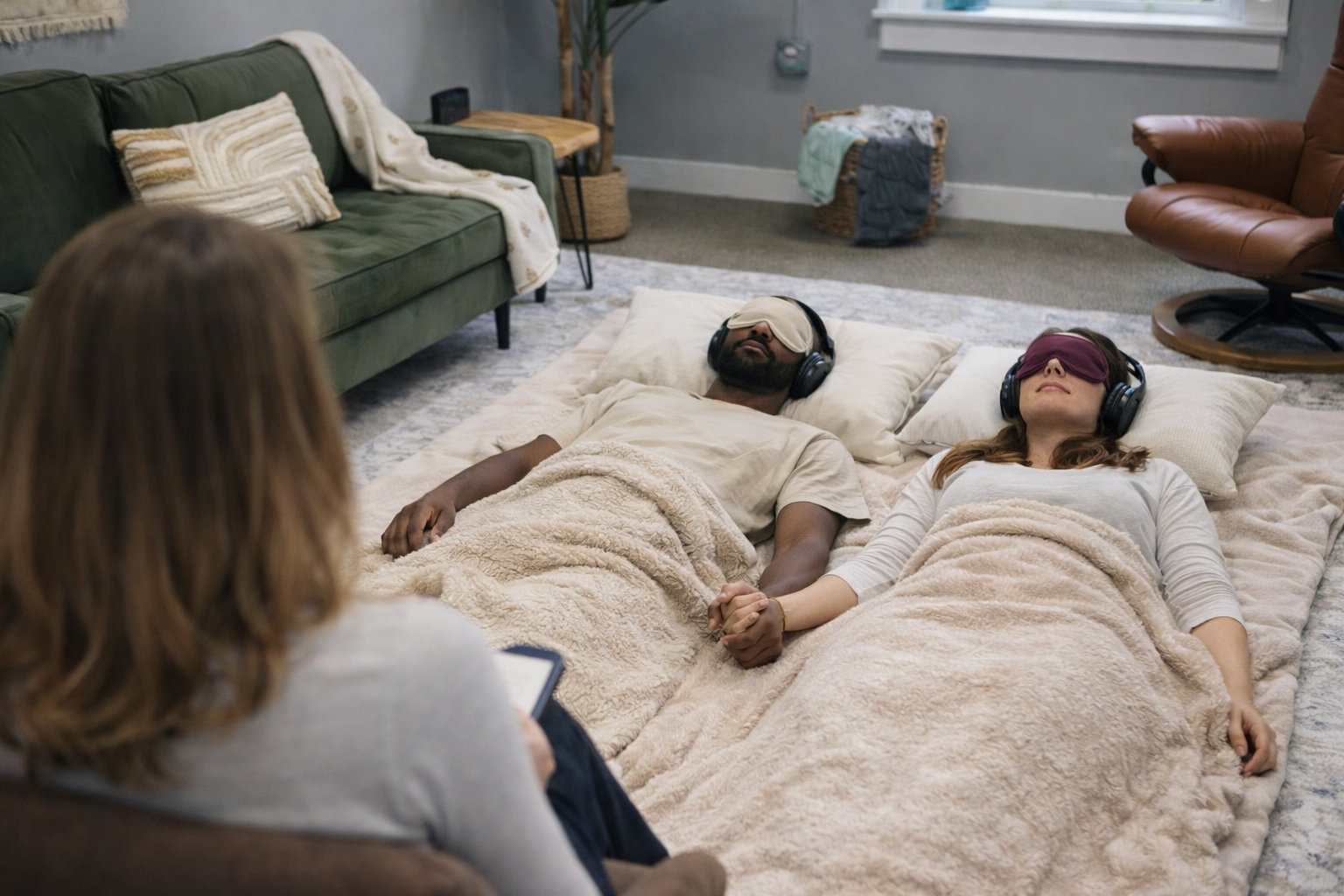
Curious about ketamine-assisted psychotherapy? Learn what KAP is, how ketamine works, its history, safety, preparation, integration, and how it may support individuals and couples.
If the first thing that comes to mind when you hear the word ketamine is a party drug, you're definitely not alone.
Maybe you've heard about ketamine therapy from a friend. Maybe your psychiatrist mentioned it. Maybe you've read something about it being used for depression or trauma. Or maybe you landed here because traditional talk therapy has helped you understand yourself beautifully... and yet, somehow, you still feel stuck.
So, what exactly is ketamine-assisted psychotherapy?
Is it new?
Is it the same as psychedelic therapy?
Is it safe?
Why would you take ketamine with a therapist? Can't I just do it with a trusted friend?
And what could it possibly have to do with your marriage?
There is a lot of information out there. And honestly, some of it is confusing. Why would you sign up for a ketamine retreat if you don't understand it completely?
So let me tell you a bit more about it.
What Is Ketamine-Assisted Psychotherapy?
Ketamine-assisted psychotherapy, usually shortened to KAP, combines the use of ketamine with psychotherapy.
And that distinction matters.
Ketamine is not the therapy.
It's a catalyst. It may help quiet some of the mental noise, soften rigid ways of thinking, and create enough distance from your usual narratives that you can experience yourself, your emotions, your history, or your relationships from a different perspective.
But the medication is only one part of the process.
Psychotherapy gives us space to process and make sense of whatever comes up.
An emotion you haven't been able to access.
A memory.
A body sensation.
Grief you didn't realize you were still carrying.
A completely different way of seeing yourself.
Or maybe nothing dramatic at all. Just a subtle sense that something feels different.
We carefully prepare before the ketamine experience. I stay with you while you are in that altered state. And afterward, we work together to understand and integrate what came up.
That is KAP.
It is not simply taking ketamine and hoping something changes.
Ketamine Is Not a New Drug
Ketamine may feel new because conversations about psychedelic and ketamine-assisted therapies have become much more visible in the past several years.
The medication itself is not new at all.
Ketamine was first synthesized in 1962 and tested in humans in 1964. In 1970, the FDA approved it as a general anesthetic. It was used extensively as a battlefield anesthetic during the Vietnam War and has continued to be used in anesthesia and emergency medicine for decades.
So, ketamine did not begin in a therapist's office.
And it certainly did not begin as a party drug.
Its medical history came first.
Researchers later became interested in something else ketamine seemed to do. At doses lower than those used for anesthesia, it appeared to have rapid effects on depression symptoms in some people. That led to decades of research into ketamine and related medications for mental health treatment. NIMH-funded research has found rapid antidepressant effects in some people with difficult-to-treat depression, sometimes within hours rather than the weeks traditional antidepressants may require.
Today, ketamine itself is FDA-approved as an anesthetic. When ketamine is prescribed for psychiatric purposes, that use is generally considered off-label. Esketamine, a related medication given as a nasal spray, has separate FDA approvals for certain depression indications.
That's an important distinction, and one that sometimes gets lost when people simply refer to all of it as "ketamine therapy."
So Why Ketamine for Mental Health?
Here is where things get interesting.
Traditional antidepressants typically work on chemicals like serotonin or norepinephrine ("feel-good hormones"), and it can take some time before you start to notice a difference. Ketamine works differently. It "awakens" the brain's glutamate system, including its NMDA receptors. This neurotransmitter helps the brain become more flexible and form new neural connections.
And that flexibility is important. It can help loosen some of the patterns your brain has been stuck in and create space for something new. Some people notice a shift after their first ketamine session, while for others, the benefits build over several treatments.
In plain English?
Ketamine may temporarily make the brain more flexible and receptive to change.
I sometimes describe it as softening something that has become very rigid.
For years, you may have followed the same mental path:
I'm not good enough.
I can't trust anyone.
Nothing will ever change.
If I let people get close, they'll hurt me.
I have to take care of everyone.
You know the path so well that your brain seems to travel down it automatically.
Ketamine may create a little more space around those familiar thoughts.
Of course, that doesn't mean a few hours or a few sessions suddenly erase everything that has been hurting between you. Ketamine won't magically replace all your negative thoughts with positive thinking.
But when a ketamine retreat is combined with EFT, it can help soften some of the defenses, settle the nervous system, and give you a new felt experience of being connected. It can give you just enough distance to notice:
Wait. Is this the only way of seeing this?
And sometimes, that little bit of space matters.
That experience becomes something you can return to, strengthen, and keep building on over time.
I Like to Call Ketamine a "Medicine of Perspective"
For me, one of the most interesting things about ketamine is the chance to see something familiar from a different angle.
You may suddenly see the bigger picture instead of being right in the middle of the problem.
Or you may go inward and notice feelings you've spent years defending against.
You may recognize how much fear sits underneath your anger. How much grief sits underneath your independence. How exhausted you are from constantly anticipating what everybody else needs. How badly you want connection even though another part of you has spent years keeping people at a safe distance.
Ketamine may help quiet some of the repetitive mental chatter and loosen the grip of the stories you have told yourself over and over again.
It may also soften some of the defenses your nervous system has relied on for years.
And let me be clear: those defenses are not bad.
They developed for a reason.
Maybe withdrawing kept you safe. Maybe taking care of everyone helped keep the peace in your family. Maybe becoming hyper-independent meant nobody could disappoint you. Maybe staying busy meant you didn't have to feel what was underneath all that productivity.
Those strategies may have helped you survive something difficult.
The problem is that sometimes the thing that protected you then becomes the thing keeping you stuck now.
KAP gives us an opportunity to become curious about that.
Does Ketamine Have to Feel Profound to Work?
No.
Please don't go into ketamine therapy thinking you have to revisit your entire childhood, see your life flash before your eyes, and come back with the meaning of existence.
Some people have profound experiences.
Some have vivid imagery.
Some feel deeply connected to themselves or to something larger.
Some cry.
Some laugh.
Some experience an enormous sense of peace.
And some finish the session thinking: That was it?
You did not fail ketamine because there were no fireworks.
Sometimes the shift is quieter.
You notice three days later that something your partner normally says doesn't irritate you quite as much.
You notice that you paused before automatically apologizing.
You realize you were sad rather than angry.
You have a conversation you've avoided for six months.
KAP's therapeutic value isn't measured by how dramatic the experience was. What matters is what we become curious about afterward and what you begin doing differently with it.
You might also find helpful: Ketamine-Assisted Psychotherapy for Couples: 6 Common Myths About KAP That Keep People Confused
Who Might Consider Ketamine-Assisted Psychotherapy?
KAP is not something everyone needs simply because therapy feels difficult.
Traditional psychotherapy can be incredibly effective. But there are people who tell me: "I understand everything. I just can't seem to change it."
They have spent years in therapy. They understand their attachment patterns. Their trauma history. Their triggers. Their defenses. They can explain exactly why they react the way they do.
And still...
When something happens in real life, their body responds before all that insight has a chance to help.
They shut down. They become overwhelmed. They move into the same old protective response. They know better, but knowing and experiencing something differently aren't the same.
For some people, an experiential therapy like KAP may offer another way into the work. When used alongside emotionally focused therapy for couples, ketamine can open your heart and help you finally move out of resentment, exhaustion, and disconnection.
For example, you may know intellectually that your partner's anger actually comes from a fear of losing you. But in an argument, you still hear criticism and judgment, and your body just shuts down. And for your partner, while they know rationally that your silence is protective, in that moment their nervous system reads it as abandonment.
But ketamine is not appropriate for everyone.
Your medical history, psychiatric history, current medications, substance use, cardiovascular health, and other factors need to be reviewed by a qualified medical provider before treatment. Ketamine also carries risks, including adverse effects and misuse potential, which is one reason careful screening and professional monitoring matter.
The goal is not to "qualify" for ketamine.
The goal is to figure out what kind of treatment actually makes sense for you.
You might also find helpful: Is Ketamine Therapy a Good Fit for Your Marriage? What Couples Should Know
What About Ketamine Therapy for Couples?
This is where my work gets especially interesting.
I have worked with couples for years, and I see the same frustration again and again.
You have done therapy for years. Maybe even you both did it individually and as a couple. You spent hours and hours talking, unpacking, revisiting, and figuring things out.
So, you do understand your patterns. You can recognize what drives them. You understand the "dance." You can predict the steps. You know who pursues and who shuts down. You know things logically. You may even know exactly which childhood wound gets activated whenever your partner doesn't answer your text or goes quiet during an argument. Why one of you desperately wants to feel important. And why the other feels attacked, inadequate, overwhelmed. Why one of you always demands. And why the other shuts down.
So why do your conversations still feel more like an endless to-do list than a real dialogue between two people who deeply care about each other, and who once felt deeply connected and passionate?
Why do you still get activated the moment he says something that doesn't land quite right?
Oh, yes... You still love each other deeply. Maybe you're not even considering divorce. But for years now, you've been feeling more like business partners or roommates than romantic partners. It's frustrating. It's exhausting. And it's a heartbreaking pattern I've seen in so many couples.
Still, there's a way to break years of disconnection.
This is why I combine ketamine-assisted work with emotionally focused therapy for couples when appropriate.
EFT gives us the relationship map. It helps us understand what is happening between you, the attachment fears underneath the conflict, and the cycle that keeps pulling you apart.
Ketamine may help soften some of the defenses around that cycle. Instead of immediately protecting yourself, you may be able to stay with the hurt underneath the anger. Instead of hearing your partner's vulnerability as criticism, you may actually be able to take it in. Instead of saying, "Here we go again," you may see the person sitting across from you a little differently.
That doesn't mean ketamine fixes marriages.
It doesn't.
But for some couples, KAP may create an opening for a different kind of emotional experience.
And then we work with that opening.
You might also find helpful: Ketamine Therapy for Couples: When Talking About the Problem Isn't Enough.
Is KAP Right for Your Marriage?
Here's something I want to say that very clearly: not every struggling marriage needs ketamine.
Some couples make meaningful changes in traditional weekly marriage counseling Wake Forest. Others benefit enormously from an intensive marriage retreat Norh Carolina where we have more time to stay with the difficult material instead of stopping after 50 minutes.
And for some couples, ketamine therapy may become part of that work.
You worked so hard. On yourself. On your marriage. You know that when you pursue, she withdraws. That when you become critical, he shuts down. You may even be aware that your childhood taught you to be cautious in relationships. That your attachment style made you sensitive to rejection.
And yet, when it happens again, you still feel stuck, almost exactly where you were at the beginning. Your body goes into stress-survival mode. Your muscles tense. Your breathing becomes faster. Your heart rate increases. You cry, yell, or lash out. Or you freeze, go numb, and simply shut down.
You want the relationship to work, but you keep finding yourself pulled back into the same automatic reactions.
Let me tell you something I remind my clients of all the time: knowing your patterns and changing your patterns are not the same thing. You can analyze the struggles in your relationship and still react the same way when emotions run high.
But both partners still need to be willing to work on the relationship.
Ketamine cannot manufacture motivation. It cannot make someone forgive. It cannot repair trust on your behalf. And it cannot make two people want the same future if they don't.
The medicine may create perspective and flexibility.
The two of you still have to do something with it.
Let's Clear Up a Few Myths About Ketamine
Ketamine has an interesting reputation.
Depending on whom you talk to, it is either a dangerous party drug or some miraculous medicine that will cure everything after one session.
Neither picture is particularly helpful.
"Ketamine is just a party drug."
Ketamine does have a history of recreational misuse, and misuse is a real concern. But it is also a medication with more than five decades of legitimate medical use. Context, dose, screening, monitoring, and clinical purpose matter.
"One ketamine session will fix me."
I wish healing worked that way.
One experience may be meaningful. It may even feel like a breakthrough. But insight and breakthrough absolutely matter only when we do something with them. Lasting change requires integration, repetition, and practice.
"If I don't have a huge psychedelic experience, it didn't work."
Also no.
Quiet experiences count. Subtle changes count. Sometimes what matters most isn't what happens while you are under the effects of ketamine. It's what you begin noticing afterward.
"Ketamine is safe for everybody."
No medication is right for everybody. This is why medical screening, careful preparation, appropriate dosing, professional oversight, and follow-up matter. There are nuances here. A lot of them.
You might also find helpful: Ketamine-Assisted Psychotherapy for Couples: 6 Common Myths About KAP That Keep People Confused
Why Do KAP With a Therapist Instead of a Friend?
Your friend can be wonderful.
They can know you better than almost anyone. They can love you. Comfort you. Drive you home. Bring you food. Sit on the couch with you afterward and listen if you want to talk.
But that does not make them your therapist.
Ketamine can change your perception, coordination, awareness, emotional experience, and sense of time and space. Sometimes difficult emotions, memories, or body sensations emerge.
If sadness comes up, your best friend may desperately want to make it disappear.
My role is different.
Sometimes I may actually ask you to stay with that sadness long enough for us to understand where it is coming from and what it is trying to tell us. I am paying attention to patterns, defenses, trauma responses, attachment history, boundaries, grounding, and safety.
And with couples, I'm holding two nervous systems in the room.
I'm not there to take sides. I'm watching the dance between you. That professional relationship is part of the treatment. A support person and a therapist have two different jobs.
Sometimes you need both.
You might also find helpful: Why Do Ketamine With a Therapist Instead of a Friend? Safety, Support, and the Work That Happens After Ketamine
What Does a KAP Session Actually Look Like?
The exact structure depends on the person, the treatment plan, and the route of administration, but KAP generally involves several important stages.
First comes assessment and preparation.
Before medicine enters the picture, I want to understand you. I want us to have trust and rapport. We talk about what you hope for, what worries you, your boundaries, and what helps you feel safe.
Medical screening happens separately with the appropriate medical provider to determine whether ketamine is medically appropriate.
Then comes the medicine session itself.
Depending on your treatment plan, ketamine may produce relaxation, altered perception, a sense of distance from ordinary thinking, changes in body awareness, imagery, emotions, memories, or shifts in perspective.
You may spend much of that experience turned inward.
My job is not to constantly talk at you or direct every minute of the experience. I stay present. I pay attention. I help maintain the container around the work. And then we integrate.
Because ketamine is only part of the experience.
You might also find helpful: Marriage Counseling Wake Forest NC: How Ketamine Therapy Helps You Reconnect When Traditional Therapy Isn't Enough
Preparing for Ketamine Therapy Is About More Than Fasting
When people prepare for ketamine therapy in North Carolina, they usually start with the practical questions:
What should I eat?
Should I meditate?
What should I bring?
What if I can't relax?
Those questions matter.
But before anything else, preparation is about trust and safety.
Together, we create what is often called the set and setting. Your set is the state of mind you bring into the experience. Your setting is the physical and emotional environment around you.
Preparation may include grounding, setting an intention, reducing stimulation before the session, arranging childcare and meals, clearing your schedule, planning for rest afterward, and following your prescribing provider's instructions about food, liquids, medications, alcohol, cannabis, or other substances.
And yes, you also need a safe ride home. You cannot drive for the rest of the treatment day.
I often tell clients to think about preparation a little like a birth plan.
Will everything go exactly according to plan?
Probably not.
But you'll be very glad you thought about these things beforehand. The goal is not to control your ketamine experience. It's to create enough safety around you that you don't have to control everything.
You might also find helpful: How to Prepare for a Ketamine Session: What to Do Before Ketamine-Assisted Psychotherapy (KAP)
Trust. Let Go. Be Open.
One phrase you'll often hear in psychedelic-assisted therapy is:
Trust. Let go. Be open.
Ketamine temporarily changes the way you experience your thoughts, body, emotions, and environment.
Some moments may feel peaceful. Others may feel strange or uncomfortable. If discomfort comes up, we don't automatically assume something has gone wrong. We slow down. We stay curious. You don't have to decide immediately what something means. You also don't need to force your experience to follow the intention you set beforehand.
Maybe you came in asking:
Help me understand why I keep shutting down.
And the experience seems to take you somewhere completely unrelated.
That's okay.
Your job is not to perform. You don't have to "do ketamine" correctly. You get to experience. We can make sense of it together afterward.
Ketamine Is Not the Transformation. Integration Is.
You finish your ketamine session.
And then?
You go home.
Life is still there waiting for you.
Kids need you. Work piles up. Somebody leaves dirty dishes in the sink. Your partner says something in the wrong tone. Your mother calls. You're tired.
That peaceful insight you had during ketamine now has to survive Tuesday morning.
This is where integration becomes so important.
Integration is how we begin connecting what happened during the ketamine experience to the way you actually live.
Maybe you journal.
Move your body.
Go for a walk.
Talk with your therapist.
Have a conversation with your spouse.
Set a boundary.
Notice an old reaction starting and choose to pause before following it.
You do not have to reinvent your entire life. Sometimes integration is one small change. One different conversation. One moment when you recognize: Oh. This is the old pattern. And you do something slightly different.
The medicine may open the door. Integration is what helps you walk through it.
What Ketamine-Assisted Psychotherapy Cannot Promise
Ketamine is not a miracle medicine.
It cannot guarantee a breakthrough. It cannot erase trauma. It cannot repair your marriage for you. It cannot promise that every experience will feel beautiful, profound, spiritual, or even particularly meaningful at the time.
And it should not be treated as harmless simply because it is being used therapeutically.
KAP requires thoughtful screening, medical oversight, preparation, a safe and controlled environment, and careful integration. My own preparation process emphasizes readiness, trust, rapport, grounding, intentions, aftercare, medication instructions, and safe transportation home.
What ketamine may offer is an opportunity.
A little more flexibility. A little distance from the story you have been telling yourself for years. Access to something you haven't been able to reach. A different perspective.
And sometimes, that opening gives us a place to begin.
The Bigger Question Is Not "Will Ketamine Fix Me or My Marriage?"
Maybe a better question is:
Can ketamine help create enough space for me to experience something differently?
And:
Am I willing to work with whatever I discover?
Because ketamine-assisted psychotherapy is not about escaping your life for a few hours.
The whole point is to return to your life differently. Maybe a little more curious. A little less defended. More aware of what you need. More able to stay present when something uncomfortable comes up.
And, if you are doing this work with your partner, perhaps a little more able to see the person across from you rather than only the threat your nervous system has learned to expect.
Ketamine may create an opening.
What we do with that opening is the work.

Quality Marriage Counseling and Ketamine Assisted Psychotherapy in Wake Forest NC
At Marriage Counseling Wake Forest NC, I offer the best marriage counseling I can, using the most empirically validated modality, Emotionally Focused Couples Therapy (EFCT), and, when appropriate, Ketamine-Assisted Psychotherapy, to expedite results.
This is not your typical weekly kind of therapy. I am here to help couples and individuals in relationships do what has been proven to help them heal their relationships. Through marriage counseling Wake Forest NC, marriage retreat in North Carolina, individual counseling, and Ketamine-Assisted Psychotherapy, there is something for every couple who wants to heal their relationship.
Hi, I'm Irina Baechle, LCSW, in Raleigh, NC. I believe in the power of healthy relationships and write about them.
Whether you and a partner are co-creating a healthy marriage or you are single, navigating healthy relationships, my content is for you.
Let's make healthy, trustworthy marriages the norm, not the exception!
Topics I write about include marriage, infidelity, roommate marriages, sexless marriage, ketamine assisted psychotherapy, healthy second marriages, and healing after toxic or unfaithful marriages.
Have questions about marriage counseling? Visit the FAQ to find out more.